
A buyer in a children’s fitness centre has three quotations open on the same desk, and all three describe a system. The first is one box, one screen and a price. The second is the same box with a camera on a stand, described in two lines of a brochure. The third runs to four pages and includes software, report templates, training and an archive. The buyer’s question is reasonable and almost unanswerable from the documents: are these the same thing at three price levels, or three different products? They are three different products. The word system has been doing the work of a specification, and it cannot carry that weight. This article takes the word apart into the three layers that have to be present for it to mean anything — the surface that measures load, the cameras that see alignment above the surface, and the software that turns a session into a document somebody can read six months later — and then looks at what each layer produces, what a quotation tends to leave out, and how to test a listing in a single demonstration.
The word system is doing work that a specification should do
Every listing in this category calls itself a system. The word has become a courtesy title, applied to a pressure mat with a laptop and to a full assessment room with equal confidence. That is not dishonesty so much as shorthand: system sounds like more than device, and buyers read it as a promise of completeness. The useful move is to ask what the completeness consists of, because the answer is stable across every genuine offer in the market.
Three layers, in the order a session uses them. A sensing layer that records load where the foot meets the ground, in time as well as in place. A camera layer that records what is happening above the surface, because the same load map means different things under a knee that tracks inward and a knee that tracks straight. And a software layer that names the items, assembles them into a document, keeps the document, and allows two sessions to be put beside each other. Remove any one of the three and what remains is an instrument, not a system.
The distinction is not academic, because each missing layer changes what a buyer can sell. A sensing layer alone sells a measurement. Sensing plus cameras sells an explanation of the measurement. All three sell a record that can be repeated, compared and handed to somebody else — which is the thing a clinic, a sports institute or a shoe shop with a fitting service actually needs, and the thing a customer returns for.
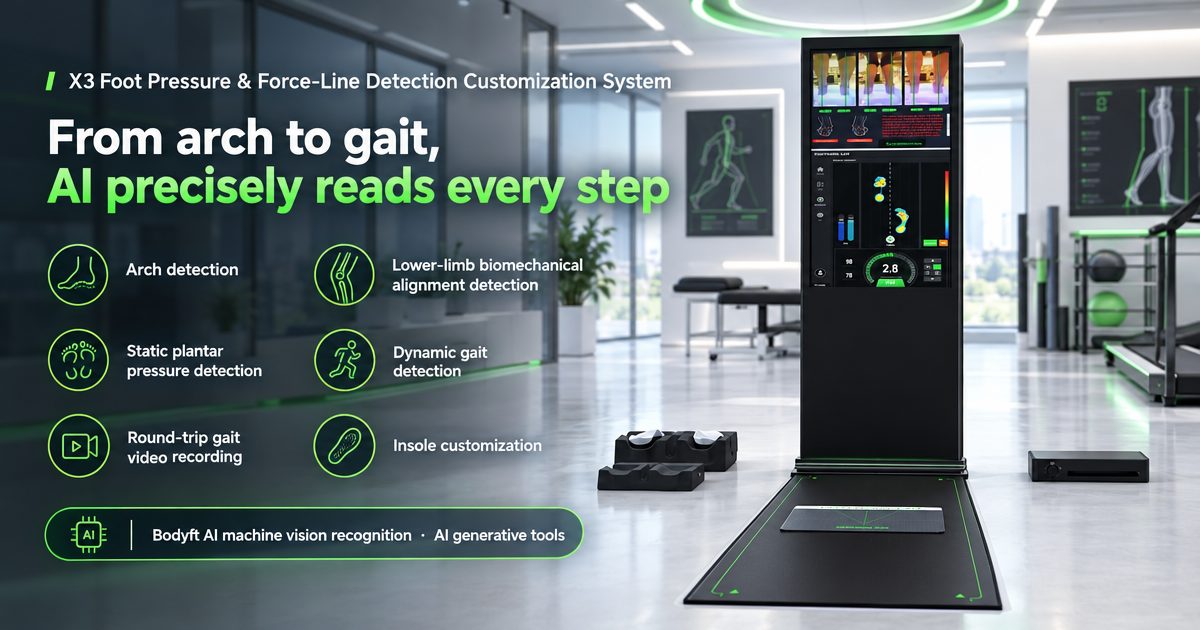
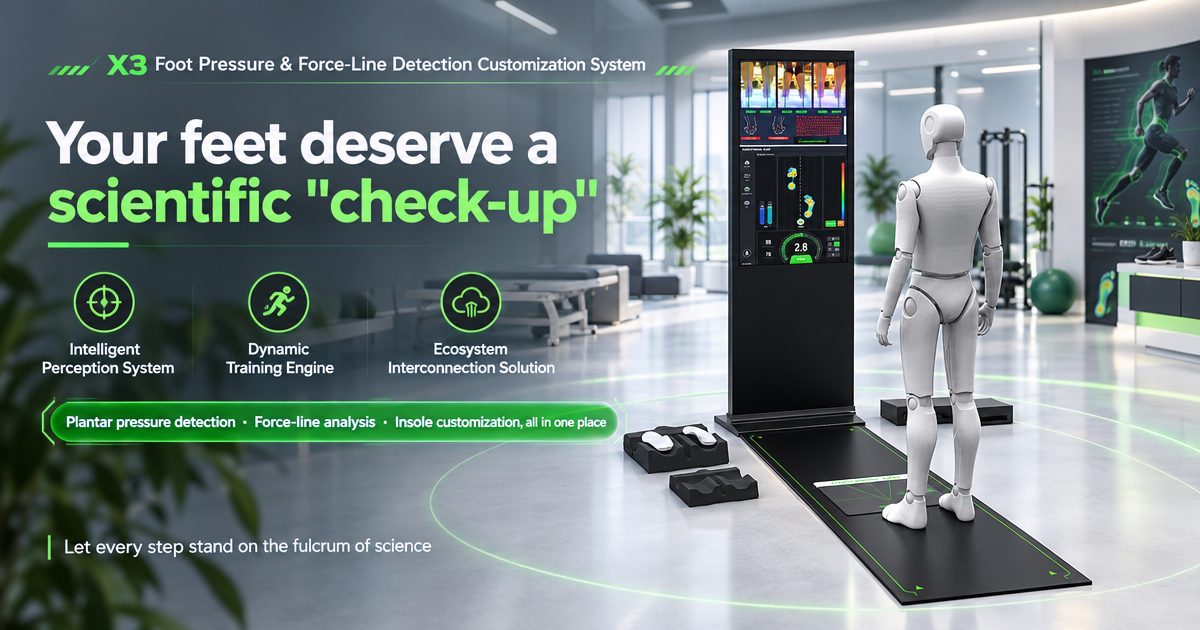
The system discussed here is the X3, which carries all three layers and a fourth function that sits on top of them: insole customisation, driven by the same record. It records arch condition, lower-limb alignment, static pressure, dynamic gait and a round-trip video, and it produces a report that can leave the room by code, by email or on paper. That is the shape of the answer. The rest of this article is about what each layer contributes and where listings get thin.
The sensing layer records load, in place and in time
The surface is a woven fabric sensor array — Sinmec Fabric — rather than a plate of discrete pads, which matters for a simple reason: a foot does not land on a grid. A woven surface reports a continuous field, so the values that come out describe regions of the sole rather than the nearest sensor to them. What the software then names is a set of quantities: peak and mean pressure under each region, the area in contact, the path the centre of pressure takes and how fast it travels, and the proportion of the step spent in contact and spent flat.
Static and dynamic passes answer different questions and a system should offer both. A static pass describes how load sits when nothing is moving: where the weight goes, how much of the sole is engaged, how the arch presents at rest. A dynamic pass describes what happens when the foot is doing its job, and the numbers change character — now the interest is in timing, in the sequence of contact, in whether the centre of pressure runs a straight line from heel to forefoot or drifts. A foot can look unremarkable in one and produce a very different set of values in the other.
The layer has limits that should be stated as plainly as its outputs. It records load; it does not see the shape of the foot, and it says nothing about the condition of the tissue under the skin. It is also sensitive to routine: barefoot or not, stance width, approach speed, the first pass across an unfamiliar surface. A clinic that standardises the instruction and the position gets records it can compare; one that lets each person walk as they please gets a set of attractive images and no baseline.
What the layer is good for commercially is the retest. Because the quantities are named, the same quantity can be put beside itself from three months ago, and that comparison is a reason to book an appointment rather than a reason to buy a pair of insoles and disappear.
The camera layer sees what the surface cannot
Load without alignment is half a sentence. The lower-limb camera records heel position, the angle of the foot axis, how the knee tracks as the foot rolls forward, and the direction the shin carries through the step. Those are the items that turn a footprint into a force-line record, and they are the ones a footwear or insole specification is actually written against. A pressure map alone tells a fitter that load concentrates under the inner edge; the camera tells them whether the foot is rolling that way because of the way it lands or because of what is happening above the ankle.
The second camera looks higher, at the column above the base: pelvis level, shoulder height, head position, and how the whole stack sits over the feet. In a children’s setting this is often the reason the parent came in — a shoe that wears unevenly, a stance that looks asymmetric — and it is the layer that turns a foot session into a posture record. The items are angles and offsets, recorded as values, not as verdicts.
The X3 also records a round-trip video: the person walks away from the camera and back again. This is a small feature with a disproportionate effect, because a single pass across a surface catches the foot in one phase of one step, while a walk away and a walk back shows whether the pattern is the same on both directions and both sides. Asymmetry that is invisible in a pressure map is often obvious in the video, and the video is also the artefact a parent or a customer will actually watch, which matters more than any table.
What the camera layer does not do is measure the shape of the foot. There is no surface reconstruction, no point cloud to carve from, and no laser in the unit. A workshop that needs geometry for a milling workflow needs a different category of equipment, and we say that at the first enquiry rather than the third meeting, because a buyer who discovers it after delivery has bought the wrong thing through no fault of their own.
The software layer is where a session becomes a record
The third layer is the one buyers examine least and use most. It takes the named quantities from the surface and the angles from the cameras, arranges them on a page, and produces something a person can read in ninety seconds at a counter or ten minutes in a clinic. That page is the product of the whole system. Without it, the first two layers produce numbers that live in a folder and are never opened again.
Three functions belong to this layer and each has to be present. It has to name things in language the reader uses, so a fitter can point at a line rather than interpret a colour. It has to export, because a record that cannot leave the room is a record that cannot be sent to a referring clinician, printed for a customer, or attached to an order. And it has to archive, because the value of a second session depends entirely on the first one still being there in a form that can be put beside it. The X3 does all three: a code the customer scans, an email, or a print on the spot.
The customisation module sits on top of the same record rather than beside it, which is the point of buying the layers together. The X3 works from a shoe library that has to be loaded before any recommendation means anything: the software matches the recorded items against styles in the library and proposes a set, and a proposal made against an empty library is a guess wearing a label. Once the library exists, the record, the recommendation and the insole order refer to the same session, which is what stops a fitting service from becoming a series of unrelated conversations.
The report text itself is drafted by the software from the recorded values, and this is where a supplier’s discipline shows. A generated paragraph that reads like a conclusion is a liability; the report has to state what was measured, in what conditions, on what date, and leave the reading to the professional who signs it. We build the wording that way deliberately, and we would rather the page look plain than look certain.
What a quotation leaves out, and where the third layer hides
Three quotations for the same category rarely differ because one supplier is cheaper. They differ because they are quoting different scopes, and the scope that disappears first is the third layer. Software is quoted as a licence, a subscription, a per-report charge or nothing at all, and “nothing at all” usually means the reports live somewhere the buyer does not control. The second thing to disappear is training: a system demonstrated by an expert and handed over without a routine is a system that will be run five different ways by Friday.
Price composition, not price, is the honest way to compare. A quotation for this category is built from the sensing surface and its size, the cameras and their stands, the host, the software licence and how many report templates are included, the training days, the freight mode, and the service wrapped around the unit afterwards. Two offers that differ by a wide margin are usually differing on one of those lines rather than on the quality of the sensing surface, and the buyer can find out which by asking for the lines separately. We do not quote a single bundled figure for a system, because the layers are priced separately and a bundle hides which one is thin.
The request that settles most of it is a sample report with the name blocked out and the date left in. Read it as a document rather than as a brochure: does it name quantities and units, does it state the conditions of the session, does it show left beside right, does it say what the reader should do next, and does it carry a line making clear that interpretation belongs to a professional. A report that is a list of recommendations with no values behind them is selling an opinion, and the buyer should ask who is accountable for it.
Ask two more questions while the quotation is open. Who owns the records, and in what format do they leave? And what happens to the software in year three — does it keep working offline, do updates arrive over the air, and is there a charge for either? We answer both in writing, because they are the questions that decide whether a system is still useful when the novelty has worn off and the unit is being used by somebody who was not in the room when it was sold.
Testing whether a listing is a system, in one demonstration
Five checks will separate a system from a box, and all five can be done in a single visit. Does the surface report time as well as place — can it show a sequence rather than a snapshot? Do the cameras see above the ankle, or is the second camera a webcam pointed at the feet? Is there a document at the end, and can it be read by somebody who was not present? Can two sessions be compared away from the unit, on a screen in another room? And can the data leave — exported, printed, emailed — without asking the supplier’s permission?
A sixth check is worth adding for anyone buying in a shop rather than a clinic: ask the demonstrator to run a session on a person with no complaints. A system that produces a page of alarming language for a healthy foot is a system that will frighten customers and embarrass staff. The output for an unremarkable foot should be unremarkable, and the language should stay descriptive even when the values are unusual.
We are clear about what we do not do, because a system word invites assumption. We do not capture foot shape: there is no laser in the unit and no surface model to carve from, and the shorthand buyers type into search boxes is a habit of the market rather than a description of our equipment. We do not diagnose, and no report item is a finding — each is a recorded value, and reading it belongs to a qualified professional. We do not publish figures, because configuration, destination and service decide a quotation. And we do not promise exclusivity by region; that is a distribution agreement with obligations on both sides, not a line in a brochure.
Frequently asked questions
What makes a foot pressure system a system rather than a device?
Three layers present at once: a sensing surface that records load in place and in time, cameras that record alignment above the surface, and software that produces, exports and archives a document. Remove one and what remains is an instrument rather than a system.
What does the X3 record in each layer?
The surface records static pressure, dynamic gait, contact area and centre-of-pressure behaviour. The cameras record lower-limb alignment, foot axis, heel position and posture, plus a round-trip walking video. The software assembles those into a report that can be scanned, emailed or printed.
Why does alignment matter if the pressure map already looks clear?
Because the same load pattern can come from different mechanics. Load concentrated on the inner edge means one thing under a knee that tracks inward and another under a knee that tracks straight. The camera layer supplies the part of the sentence the surface cannot.
Does the software need a network connection?
No. Reports are produced on the host and can be printed, scanned or emailed from the room. A network connection is what allows updates to arrive over the air, which is convenient rather than essential.
Why must a shoe library be loaded before a recommendation?
Because the recommendation is a match between recorded items and styles that exist in the library. Run against an empty library, the software has nothing to match against, and the output is a guess with a label on it.
What should a buyer ask for before signing?
A sample report with the name removed and the date left in, a breakdown of the quotation by line, a written answer on who owns the records and in what format they export, and a statement of what software updates cost after the first year.
Does the X3 scan the shape of the foot?
No. It records pressure, alignment, posture and gait, and it produces a report and an insole specification from those values. There is no surface reconstruction and no laser, and a workshop that needs geometry should look at another category.
What we would do next
Take the three quotations you already have and mark which of the three layers each one actually includes. Most buyers find that the cheapest offer is missing the third, and that the difference in scope explains the difference in price. Send that marked comparison through the contact page and we will go through it line by line, including the offers that are not ours.
The X3 system page sets out the record items and the customisation module in the equipment’s own terms, which is the right place to start a specification. Podiatry testing runs on three subsystems makes the same argument from the clinical side, and biomechanical analysis ends in a report follows the chain from capture to document.
One more piece is worth reading before a demonstration. Dynamic plantar pressure mapping on the F2 describes what a walking pass adds to a standing one, which is the clearest illustration of why the sensing layer alone is not the whole story.
This article is intended for professional and educational reference. It is not medical advice. Foot assessment equipment produces measurements and images; clinical interpretation and any decision about care remain the responsibility of a qualified professional. Certification scope is limited to the documentation we hold: European Union certification and ISO quality system certification.