
The son arrives ten minutes before his mother and opens with an apology: “She speaks a little of the local language, but not for things like this — I will translate.” From that sentence onward, every exchange in the session will pass through a third person. The greeting takes twice as long. The first question about her feet produces an answer that lasts half a minute in her language and comes back as four words. When you ask her to walk across the room, you watch her look at her son, not at you, before she moves. The assessment ahead is entirely ordinary in its mechanics and entirely new in its conversation, and most of what decides whether it succeeds has nothing to do with feet.
Working through an interpreter is a regular fact of practice in port cities, border regions, and any clinic near a community that arrived from somewhere else. Sometimes the interpreter is a family member with no training and a strong opinion. Sometimes it is a phone service with a stranger who has never seen a foot assessment. Either way, the professional runs a session where meaning travels a longer road than usual, and the parts that get lost on the way are rarely the clinical ones. They are the small words — where, when, how much, which one — that a walking record quietly depends on.
The third person in the room
Before any technique, it is worth being honest about what a third person does to a conversation. The customer now has an audience for her complaints, and the audience is someone she may see at family dinners. Statements she would make freely to a clinician — about how far she can walk before stopping, about what she avoids, about what frightens her — get edited, softened, or replaced with something more presentable when the translator is her son. This is not deception; it is what people do in front of relatives.
The interpreter has pressures of his own as well. Family members rarely translate verbatim; they summarize, because summarizing is faster and because they believe they already know the answer. A question about when the difficulty started can come back as a five-second exchange followed by “She says it is fine.” The son may also advocate — adding context you did not ask for, discounting complaints he considers exaggerated, or steering the session toward the outcome the family has already decided it wants. None of this comes from bad intent. It comes from wearing two roles at once: translator and family.
A professional phone interpreter sits differently in the room but carries different weights. The stranger translates faithfully, word for word, which sounds ideal until you notice that faithfulness strips out the gesture, the wince and the pause that carry half the meaning of a foot conversation. The stranger also cannot see the floor plan of the room, so anything you want communicated while moving — walk to the far wall, stop at the line — has to be arranged in advance or the translation arrives after the customer has already made her own decision about where to walk.
What gets lost on the way
Foot conversations lean heavily on small words that translate badly. “When does it start?” assumes the customer divides her day the way you divide yours. “Does it go up the leg?” leans on a spatial metaphor that may not exist in her language, or may exist with a different shape. Descriptions of sensation are the worst territory of all: languages carve the territory between comfortable and unbearable along different lines, and the ordinary vocabulary of aching, burning and throbbing has no obligation to have siblings elsewhere. The customer is not being vague; her language sorts the experience differently, and the interpreter does arithmetic between two maps.
Politeness does its own quiet damage. In many speech cultures, contradicting a professional directly is rude, so “yes” may mean “I heard you” rather than “I agree,” and “it is better now, thank you” may be gratitude rather than a report. A nodding customer translated by a nodding son can produce a session that felt smooth and recorded almost nothing. Watch for agreement that arrives suspiciously fast; the fast yes is often the polite one.
Finally, the third person changes the walk itself. Being observed by one stranger alters a gait record; being observed by a stranger while a family member narrates your every move alters it differently. Some customers walk more carefully with their son present, unwilling to demonstrate in front of family what they described in private. Others relax visibly once their own person is in the room. Both are worth noticing, and both are reasons to note who was present on the sheet — the record is a measurement of that specific crossing, with that specific audience, and the file should say so.

Before the session: briefing whoever translates
Five minutes with the interpreter before the customer enters pays for itself many times over, and the briefing has four parts. First, the rule of the first person: ask the interpreter to translate what the customer says in her voice — “I say: my foot hurts at night” — rather than reporting about her — “She says her foot hurts.” First-person translation keeps the conversation pointed at the customer, which is where you need it, and it makes summarizing visibly awkward, which discourages it.
Second, hand over the short list. Write down the six or eight terms the session genuinely depends on — arch, heel, toes, big toe, both, standing, walking, resting — and walk the interpreter through them before the customer arrives. If the interpreter is a family member, this list also calibrates him: seeing the vocabulary written down signals that precision matters here and that his usual shortcut of paraphrase will cost something. If the interpreter is a phone professional, the list lets her ask you for context while the waiting room is still empty rather than mid-session.
Third, set the frame about what the session is and is not. Say it plainly to the interpreter, and have it repeated to the customer in her language at the start: the equipment records measurements and images of how the foot carries load; it does not diagnose; interpretation and any decisions belong to the qualified professional. A sentence like this, translated once at the beginning, protects the whole session from the customer arriving at expectations the room never promised — and it protects the interpreter from being recruited into promises on your behalf.
Fourth, agree the hand signals. In a session where every spoken instruction takes a detour, a small agreed vocabulary of gestures — point where to walk, flat hand for stop, come here — lets the mechanics of the capture run without waiting for translation. It feels informal. It works.
During the capture: keep the instructions boring and early
A crossing under measurement needs instructions that are short, identical and delivered before the walking starts, and this matters double through an interpreter. Anything said while the customer is mid-crossing has to be translated, and the translated version arrives while she is already three steps past the point it referred to. The result is a stop-and-restart capture that measures a conversation as much as a walk. Give the whole instruction package once, at the edge of the platform, in the interpreter’s presence, and let it be translated in a single block: where to start, where to walk, where to turn, that nobody will speak during the crossing, and that she should look wherever looking feels natural.
Then stay quiet, visibly. In interpreted sessions the professional’s silence is harder for the customer to read — she cannot catch your tone in words she does not share — so the interpreter should tell her, in her language, that the silence is planned and means the capture is working. That single sentence, delivered before the first pass, prevents the anxious glances toward the family member that otherwise punctuate every interpreted crossing.
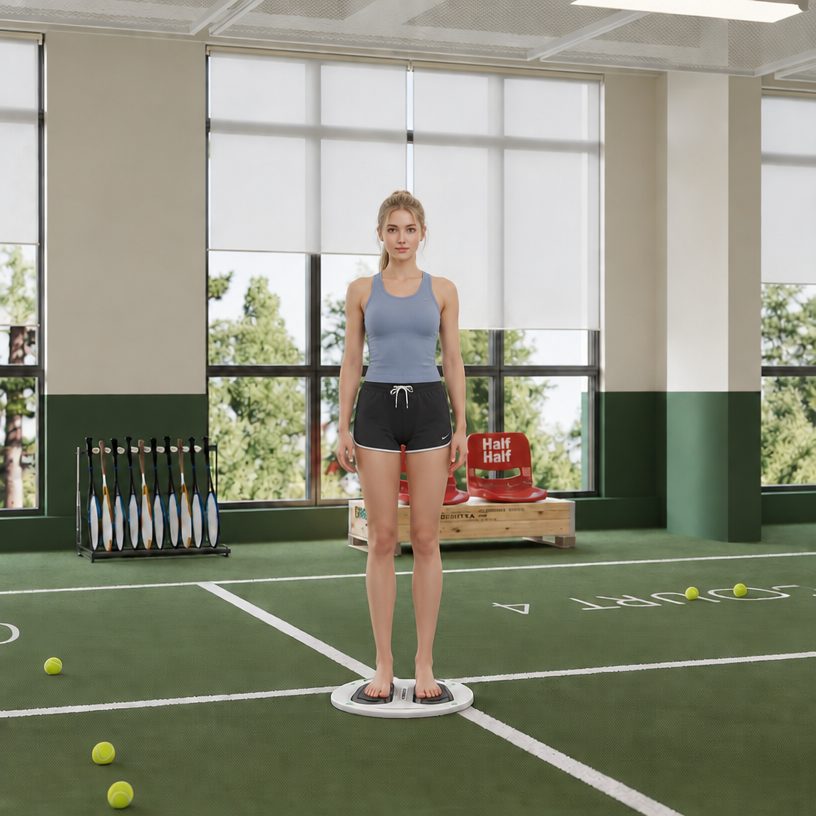
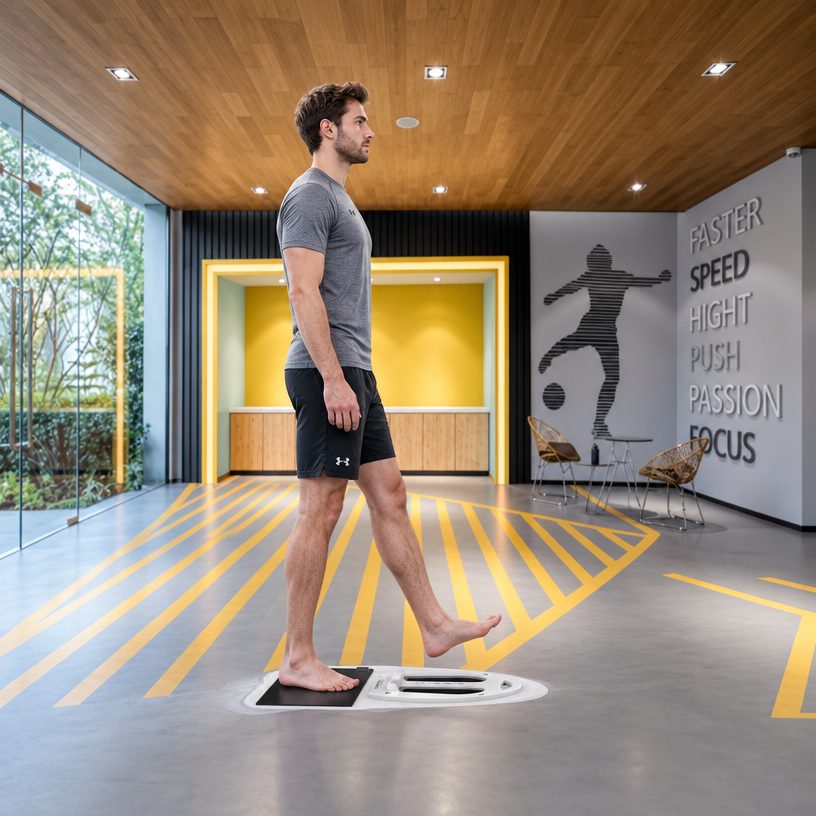
Keep the number of passes honest as well. In a session where every question costs double, there is a temptation to declare the first usable pass final and move on. Resist it if the passes disagree. One extra crossing, with its small translation overhead, is cheaper than a record whose conditions nobody can describe afterwards. The measurement itself stays a tool: a pressure platform such as the F2 plantar pressure system records the crossing without caring which language the room was speaking, and what the recorded line means belongs to the qualified professional reading the whole file.
The demonstration advantage
Interpreted sessions reward showing over saying, and a foot assessment is unusually rich in things that can be shown. The instruction “walk across here” collapses into pointing at the start line and taking the walk yourself once, at ordinary speed, while the customer watches. The question about where the foot bothers her becomes a silhouette drawing she can mark with a finger, no translation required — the mark goes on the sheet in the position she chose, and the position is data. Even the idea of walking versus standing can be demonstrated with a raised foot and a planted one, and customers understand both instantly, whatever they dream in.
The measurement image is the best demonstration object in the room, used at the right moment. When the capture is done, turning the screen toward the customer and letting her see her own footprints does something spoken language struggles with at any distance: it makes the session concrete, shared and hers. Point at the heel, say the word for heel, let the interpreter carry it — the customer connects the picture to her own foot faster than any sentence could manage, and she starts asking her own questions, which is the moment the session stops being an interview and becomes a conversation.
That shared-image moment also carries the honest framing better than words can. What is on the screen is a measurement of load distribution on a specific day — nothing more claimed, nothing less — and what it means for her walking is a question for the qualified professional, with her, in her language. There is a fuller discussion of talking a customer through a pressure map without alarming or over-promising in Saying the Map Out Loud: Words That Reassure and Words That Alarm, and every word of it applies double when the words must cross a language line.
Documenting in two languages
The sheet deserves extra care in interpreted sessions, because the file is the only place where the full conversation will ever exist. Four habits cover it. First, record who interpreted and in what relationship to the customer: “son, family member” or “phone service, booked by clinic.” A reader of the file should be able to weigh every translated sentence against who carried it, and cannot do that from an unnamed presence.
Second, keep the customer’s key statements in her own words wherever the interpreter can supply them. If her language can be written down — by the son, by staff who share it — a line of her original words next to the translation is worth more than any polished summary, because it lets a future reader who shares the language check the road the meaning traveled. Where writing is not possible, a careful note of what she said in translation, marked as translation, still beats a paraphrase presented as her voice.
Third, note the demonstration data that arrived without language: the mark she made on the silhouette, the spot she pointed to on the map, where her eyes went during the crossing. These observations came to you directly, unfiltered by anyone’s summary, and they deserve to be recorded as what they are: observed behavior, not reported feeling. Fourth, record the audience: who was present in the room during the capture. The crossing happened in front of her son, and the file should say so, for the same reason it should say whether she held a rail.
When the family member is the interpreter
Sometimes the son is the only option, and the session has to work anyway. It can, with the pressures kept visible. Watch the advocacy: when the family member begins answering before the customer has finished speaking, pause him gently and address the customer directly, even through him — “Please ask her…” is a sentence that re-points the conversation at the right person without accusing anyone. Watch the filtering in the other direction too: complaints delivered in the customer’s language that come back shortened. Asking the interpreter to repeat her full answer, “as she said it,” restores it more often than not, and the request itself teaches him that the session runs on her words.
There are moments when family interpretation genuinely fails, and knowing them is part of the craft. Sensitive subjects the customer will not raise in front of her son; disputes inside the family that the translation now has to carry; anything where the customer’s account and the family’s account diverge. In those cases a phone interpreter, booked while the customer sits with a cup of tea, takes the family member out of the translator role and back into the family, which is where he is useful. This is not a criticism of families; it is a recognition that no person can be the patient’s relative and the room’s neutral channel at the same moment, and the professional who notices the collision early saves the session.
Whatever arrangement you use, the boundary from the briefing holds to the end: the equipment produced a measurement and an image; the interpretation of what they mean, and any decision about care, belongs to the qualified professional — and in an interpreted session, the professional has one extra job, which is making sure that sentence survives the trip between languages intact.
Frequently asked questions
Should I use a family member or a professional interpreter?
Family members are often available and trusted, but they summarize, advocate and filter, because they hold two roles at once. Use them when there is no alternative, and switch to a phone interpreter for sensitive subjects or whenever the family account and the customer account start to diverge in the session.
How do I explain the pressure map through an interpreter?
Turn the screen toward the customer and show rather than describe. Point, name the part, let the interpreter carry single words. The image is a measurement of load distribution on one day — say so, through the interpreter, and keep the interpretation of what it means with the qualified professional.
What if the customer answers a different question than the one I asked?
Assume summarizing or a politeness edit before assuming confusion. Ask the interpreter to repeat her answer as she said it, in the first person, and shorten your own questions to ones with concrete anchors — when, where, which shoe — rather than open invitations that invite paraphrase.
Should instructions be translated during the walking capture?
No. Give the whole instruction package once, before the first crossing, and have it translated as a single block. Anything spoken mid-crossing arrives late after translation and turns the capture into a stop-and-restart conversation rather than a measurement of walking.
What should I write on the sheet about the interpretation?
Who interpreted and in what relationship to the customer, her key statements in her own words where possible and marked as translation where not, the observations that arrived without language — marks, pointing, gaze — and who was present in the room during the capture.
How do I keep the measurement-not-diagnosis message intact through translation?
Brief the interpreter on the sentence before the customer arrives and have it delivered in her language at the start: the equipment records measurements and images of load; it does not diagnose; interpretation and decisions belong to the qualified professional. One translated sentence at the beginning protects the whole session.
Does the interpreter change the walk itself?
Often yes. Some customers walk more carefully with family present, unwilling to demonstrate what they described privately; others relax once their own person is in the room. Note who was present on the sheet, because the record is a measurement of that specific crossing with that specific audience.
What we would do next
Write the six-term vocabulary list and the first-person rule on a card this week, and keep the card in the room where sessions happen rather than in a drawer. The first interpreted customer of the month will take three times as long to brief without it and half the time with it, and the sheet will carry her words instead of her son’s summary of her words, which is a different and better file.
The deeper habit is one that outlasts any single session: treat the conversation and the measurement as two records that must agree about their conditions. That habit shows up everywhere — in how a session reads when two colleagues watched it differently (Two Colleagues, One Map, Two Opinions), and in what the file means when the customer and the map disagree with each other. Language is only the loudest of the conditions a record travels with.
If your practice sits near a community that speaks another language, tell us how you actually run it: do you brief the family member, phone a service, or have a colleague who shares the language sit in — and what is the one sentence you always insist gets translated first?
This article is intended for professional and educational reference. It is not medical advice. Foot assessment equipment produces measurements and images; clinical interpretation and any decision about care remain the responsibility of a qualified professional. Certification scope is limited to the documentation we hold: European Union certification and ISO quality system certification.