
Advertisement. This is a promotional product article.
Flat Foot Screening Equipment for Children’s Fitness Centers: Safety, Efficiency, and How to Read the Data
What is this equipment, and who turns to it?
Flat foot screening equipment is a family of measurement tools — footprint boards, plantar pressure plates, 3D foot scanners, and camera-based analysis systems — used to record how a child’s arch is shaped and how the foot carries load when standing or moving. The product line described here is documented in the FOOTWORK LAB product manual, which lists eight systems: Q1P, X1, X3, X5, F2, F2-Pro, FMP, and F5-LAB, covering quick ankle-and-foot screening, portable footprint checks, pressure and alignment measurement, and dynamic gait testing.
According to the manual, children’s fitness institutions are one of the named use scenarios, sitting alongside gyms and sports training institutions, shoe stores, and medical settings such as rehabilitation hospitals and podiatry clinics. So this article is written for two readers: operators of children’s fitness centers comparing screening systems, and parents who want to understand what a screening session at such a center involves.
One ground rule before we start: everything below is drawn from the manufacturer’s own documentation. There are no hands-on test results, no outside measurements, and no claims beyond what the manual states. Where the documentation is silent — on price, for example — this article says so plainly.
How does a screening session actually work?
The manual describes several workflows, and they differ by system.
The X1 portable system is documented as a quick-screening option. A child steps onto a temperature-sensing footprint board; the board records the footprint, and the operator can also take lower-limb alignment photos. Dedicated software collects this data and runs AI analysis on a Web-based operating system, building from footprint data and alignment images toward a foot-and-ankle health database analyzed by a large model. The documented core functions are arch detection, lower-limb biomechanical alignment detection, and AI analysis with smart recommendation. The manual states the system can be used for flat foot risk screening and gait health screening, and that AI shoe recommendation draws on shoe product information entered into the system.
Pressure-plate systems work differently. The FMove Pro main unit is built around an F2 pressure plate, and its documented assessments cover static pressure, dynamic pressure, balance pressure, and whole-body limb biomechanical alignment. It also carries an on-site module for biomechanical insole customization. The package list shows what a physical setup involves: the main unit, an installation manual and toolkit, a camera bracket, cabling with a hub, two high-precision cameras, and a set of shaping pillows sized for adults, children, and auxiliary use.
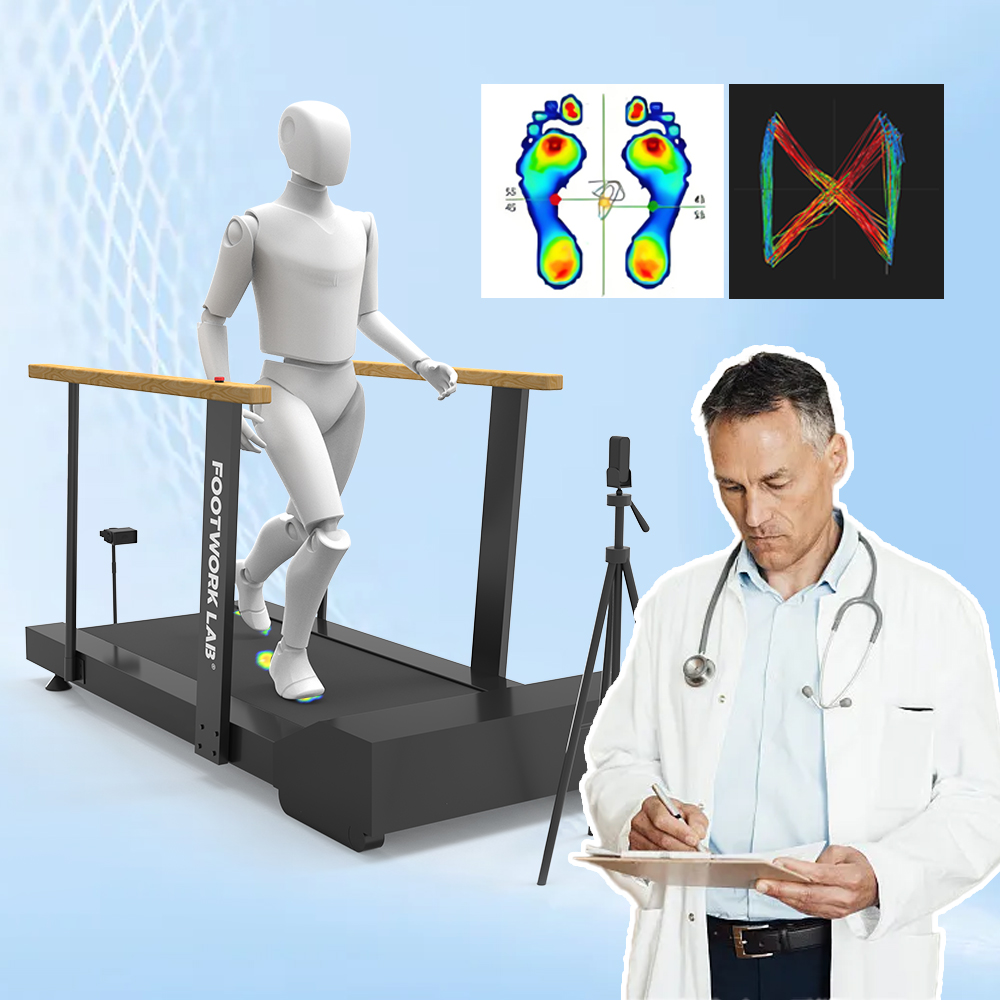
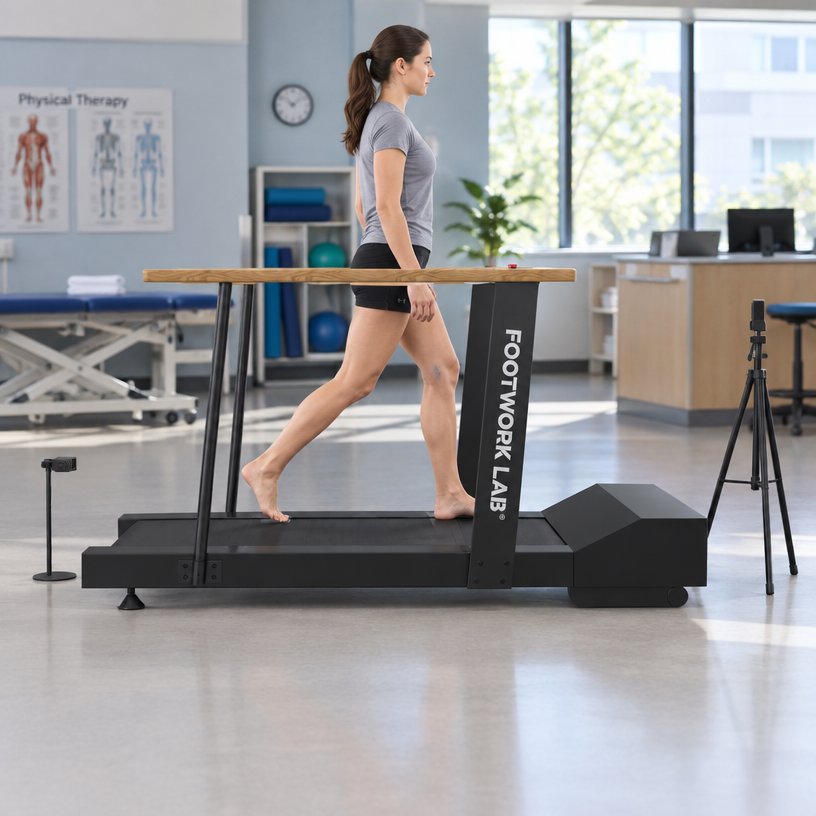
The F5-LAB system adds motion. It pairs its main unit with a treadmill and measures pressure distribution and posture while a child walks or runs. The manual says it automatically identifies strides and provides clinical gait parameters, with documented assessments covering the gait cycle, movement posture, dynamic pressure, and a dynamic two-foot butterfly-line analysis; fields the manual names for it include medical rehabilitation, sports research, and shoemaking. Two camera brackets and two cameras appear in its package list.
After collection, interpretation follows a documented path: the manual’s assessment table lists the AI digital detection system as producing footprint analysis and an arch index.
One boundary belongs here. The same table lists weight-bearing X-ray — used for angles such as the calcaneal inclination angle and Meary angle — as an assessment that requires a medical institution. The fitness-center equipment described in this article is footprint-, pressure-, and camera-based measurement, not that category.
What do the specs and numbers actually mean?
The arch index is a straightforward number to learn first. The manual defines it as the midfoot area divided by the total foot area, excluding the toes, and its classification table reads: high arch below 0.21, normal foot from 0.21 to 0.26, mild flatfoot from 0.26 to 0.30, and severe flatfoot above 0.30. A screening report that includes this index can be compared against that documented table.
Different devices output different data. According to the manual, a plantar pressure plate produces static and dynamic pressure distribution plus the COP trajectory — the path the center of pressure travels across the foot during a measurement. A 3D foot scanner records foot length, foot width, arch height, and ankle circumference. Gait video analysis, which the same table describes as a low-cost alternative using AI visual analysis, yields joint angles and symmetry readings.
The X1’s published parameters make its role easy to picture: 460×540×50 mm in size, 1.5 kg in weight, running on a Web operating system, with a body of high-strength PVC whose detection area is designated for arch type determination. In plain terms, the documented figures describe a light, portable unit whose analysis software runs in a browser.
Three named technologies recur across the line: Sinmec Fabric, a fabric-sensing technology; BodyFit AI, a machine-vision recognition module; and AI generative tools. The manual lists these as the core technologies behind measurement and analysis.
On upkeep, the documentation lists online OTA updates, meaning software arrives over the air, and notes that customizable software systems are quoted separately. For the insole side, the documentation describes custom orthotic plans as combining scan data and AI models, and describes the materials used as medical-grade — a manufacturer description, presented here as such.
Which setup fits your center, and when should you hold back?
The manual’s scenarios and specs line up into a few readable fits. If a center wants rapid checks that move between rooms or sites, the documented X1 figures — 1.5 kg, Web-based software — describe a portable screening unit. If the priority is standing load and balance, the FMove Pro with its F2 pressure plate covers static, dynamic, and balance pressure plus alignment. If walking and running data matter, F5-LAB is the documented dynamic option, with the note that it requires a treadmill and two camera brackets in the room. If screening is meant to connect directly to on-site orthotic insole production, the manual documents that module within FMove Pro and lists supporting insole customization for X3 as well.
Now the cautions, stated as conditions rather than selling points.
First, if a program needs diagnostic imaging values — the calcaneal inclination angle, Meary angle, or hallux valgus angle — the manual places weight-bearing X-ray in medical institutions, and none of the fitness-center systems documented here produce those outputs.
Second, if no one will maintain a shoe catalog, the AI shoe recommendation has nothing to draw on, since the manual states it relies on shoe product information entered into the system.
Third, budget software expectations carefully: customizable software is documented as a separately charged item, so a center should not assume every software adjustment falls under standard service.
Fourth, plan staff time for installation and operation; the package lists include installation manuals, toolkits, camera brackets, and a user manual, while documented support covers pre-sales consultation and a dedicated after-sales technical team.
A center that matches its measurement goals to these documented capabilities — and accepts the boundaries above — has a factual basis for choosing among the portable, pressure-plate, and dynamic gait options.
Where does this information come from, and what is missing?
Every product fact in this article comes from two manufacturer sources: the FOOTWORK LAB product manual and the product documentation accompanying it. Neither carries a publication date, version number, or stated validity period, so there is no documented way to confirm how current the descriptions are.
Several practical questions sit outside these materials. No prices appear, beyond the note that customizable software is quoted separately. No measurement accuracy or error figures are published, nor clinical study data or warranty terms. Response times and regional availability for after-sales support are likewise undocumented, although the manual names existing platform partners including Amazon, JD.com, and Shopify.
On safety, the materials describe construction and process choices — the high-strength PVC body of X1, the included installation manuals and toolkits — but publish no safety test data of their own.
Two boundaries frame how far these facts reach. The documented outputs are screening-level measurements; the manual’s own table assigns weight-bearing X-ray work to medical institutions, which marks where activity-center screening stops. And since the source is the maker’s documentation, capability descriptions reflect the manufacturer’s account rather than independent verification. This article summarizes one product line’s documentation and is not a survey of the wider category; readers should confirm current specifications, pricing, and service details with the seller before deciding.
Frequently asked questions
Does a screening session at a fitness center replace a medical diagnosis?
The documentation describes these systems as screening and assessment tools. Its assessment table assigns weight-bearing X-ray measurements to medical institutions, which is the documented dividing line between a center’s screening and a medical workup.
What does the arch index on a report mean?
It is the midfoot area divided by the total foot area, with the toes excluded. The manual’s table places values below 0.21 in the high-arch band, 0.21–0.26 as normal, 0.26–0.30 as mild flatfoot, and above 0.30 as severe flatfoot.
How portable is the lightest documented option?
The X1 is listed at 460×540×50 mm and 1.5 kg, with software running on a Web operating system and a body of high-strength PVC. Its detection area is designated for arch type determination.
What does a pressure-plate setup include in the box?
For FMove Pro, the documented list runs from the main unit with its F2 pressure plate through installation tools, one camera bracket, USB cabling with a hub, two high-precision cameras, shaping pillows in three size groups, a carrying bag, a heating box, and a printed user manual.
Do the analysis features stay current on their own?
Online OTA updates appear in the documented service support. Customizable software is listed as quoted separately, so custom changes are a distinct purchase from standard updates.
Can screening connect to insoles for children?
The manual documents on-site biomechanical insole customization within the FMove Pro system and lists supporting customization for X3. Among the documented custom orthotic directions is a growth-type children’s insole described as adjustable.