
The print appears on the screen before the customer has finished sitting down, and she is already asking whether the darker patch on the left is bad. For most people, this image is the first thing they have ever seen of the underside of their own feet. It arrives framed like a verdict — clinical-looking, colorful, produced by a machine in a white room — and it sits between the customer and the staff from that second onward. However carefully the appointment was planned, the first footprint starts the conversation, and the question is whether the room is ready to have it.
This piece is about that first screen: what a static footprint can genuinely promise the customer who has just seen one, what it cannot promise no matter how good the image looks, and — the practical core — how a room prepares its newer staff so the moment gets handled the same way every time, instead of depending on whoever happens to be standing nearest the plate.
The first thing the customer sees of her own feet
There is a specific kind of attention a customer pays to her first footprint, and it is worth recognising because it is stronger than anything the room says afterwards. She has walked on these feet all her life and never seen them from underneath. The image answers a curiosity she has carried since childhood — the same curiosity that made her examine wet footprints on a bathroom floor — and it lands with the force of a revelation, not a measurement. Everything she hears in the next five minutes gets filtered through what she decides the picture means, and she decides fast, usually before anyone has explained anything.
The timing compounds this. The print typically appears early in the appointment, before the history is finished, before rapport is established, before anyone has explained what the plate does. The customer is looking at it while the staff member is still setting up. And because the image looks authoritative — smooth graphics, symmetry lines, colour gradients — the default reading is diagnostic: a picture produced by a machine in a clinic must be telling her something about her health. Nobody has said so. The room simply looks like a place where machines tell you things, and she is filling the silence with the most plausible story she knows.
Which is why the first footprint is less a measurement moment than a conversation-management moment, and rooms that treat it that way get better outcomes from the same capture. The staff member who narrates the image as it appears — one sentence, before the customer’s story solidifies — is not adding information she does not have. She is occupying the silence with the accurate frame before the customer fills it with the internet’s. The next sections cover what that sentence can honestly contain, and what it must not.
What the first footprint can honestly show
Strip away the framing and the honest content of a static footprint is straightforward, and it is more useful than customers expect once it is described properly. It shows how the contact under the foot distributed while she stood still, at that moment, under those conditions: where more of her weight sat, where less did, and how the two feet compared with each other in the same instant. Those are real measurements. They are reproducible under the same conditions, they are hers rather than an average, and they give the professional something concrete to read alongside everything else in the appointment.
Two of those honest outputs deserve naming for customers, because they are the ones people find genuinely interesting. The first is the left-right comparison: the two feet of the same person, measured simultaneously, under the same load, and whether they behaved like each other. Small differences between feet are ordinary — nearly everyone has them — but the customer who has quietly suspected her two feet are different for twenty years finds this the most satisfying half of the image, whether the answer is “very similar” or “clearly not twins”. The second is the general contact shape in quiet standing: broad, narrow, heavier at the front, heavier at the heel — a portrait of how she stands, taken honestly, at that moment.
The word to hold onto is “portrait”. A footprint is a picture of one posture at one moment, taken with her weight settled as it was that day, in the conditions the room set. It is a fair and useful picture — the first accurate one she has probably ever owned of her own standing — and describing it that way, as a portrait rather than a scan-for-problems, sets every later conversation on ground that stays honest. The professional who says “this is how your weight sits when you stand still today” has said something true, complete and difficult to over-read. That sentence is the deliverable of the whole section.
What the first footprint cannot tell you
Now the other side of the ledger, and it needs saying with the same confidence. A static footprint does not diagnose anything. It does not explain why anything hurts or does not hurt. It does not show how the foot behaves when it walks, which is a different measurement requiring a different capture, and walking is what feet mostly do. It does not reveal a cause — the contact shape is a description, not an explanation, and descriptions do not carry causes inside them no matter how convincing the colour gradients look. And it does not predict: nothing on the plate says what this foot will be like in ten years, and anyone who reads a prediction into a static image is reading it in, not out.
The gap between static and dynamic deserves its own emphasis because it is where most over-reading happens. Quiet standing loads the foot one way; the gait cycle loads it quite another — weight arrives moving, rolls through, leaves moving, and the pattern under motion can differ substantially from the standing portrait. A customer who walks eight thousand steps a day and stands still for a footprint for twenty seconds has been measured on the smaller share of her foot’s working day. The standing picture is not wrong; it is incomplete, and it is incomplete in a direction that matters for almost every question a customer actually brings through the door.
The cause-versus-description distinction is the one most worth defending out loud, because it is the one customers most reliably violate in their own heads. “The front of my foot takes more of my weight” is a measurement. “And that is why my feet complain after work” is an interpretation, and interpretations belong to the qualified professional working with the whole picture — history, examination, and where appropriate further capture. The plate produces measurements and images. The meaning is made downstream of that, by a person, not a machine. Every script a room teaches its staff should carry this boundary inside it explicitly, because customers cannot know it and staff who are new may not yet believe it.
How first screens get misread — by customers and by new staff
The customer misreads in predictable directions. Darker areas read as “bad” and lighter as “good”, because the visual grammar of heat maps is everywhere in her life and nothing in it prepares nuance. She compares her print against pictures found online, whose captions promise to name what she has. She asks the internet-trained question — “is that normal?” — which smuggles a diagnosis request into three words. And she remembers the image, not the explanation: a week later she will describe her feet by the picture’s most alarming patch, in exactly the words the caption culture gave her.
New staff misread in their own directions, and knowing them is most of the cure. The most common is over-narration: filling the impressive silence with confident interpretations the plate did not license — naming conditions, explaining her ache, predicting outcomes — usually with good intentions and usually because the silence felt like a failure. The second is the certainty leak: softening “this is how your weight sits when you stand still” into “this shows you have”, a slide of two words that quietly converts a portrait into a verdict. The third is promising downstream: “we can fix that” or “this will make walking feel better” — sentences that belong to the treating professional, not to the screening moment, and that a first screen gives no evidence for.
There is a fourth, quieter failure mode: inconsistency. Two staff members in the same room describing the same image differently — one measured and careful, one chatty and confident — teach the customer that the machine’s outputs depend on who is standing there, which corrodes exactly the trust the equipment exists to build. Rooms rarely notice this because each staff member hears only themselves. The fix is unglamorous and works: one agreed script, rehearsed until it survives a busy afternoon, with the interpretive parts deliberately left out so there is nothing to drift. Scripts feel stiff for the first week and feel like the room’s voice by the second.
A script for the moment the print appears
Here is a three-sentence handover a room can adopt as-is and adjust to its own voice. Sentence one, as the image appears: “This is how your weight sits across your feet when you stand still — taken just now, as you stand today.” Sentence two, pointing if useful: “You can see where more and less of the contact is, and how your left and right compare — everyone’s two feet are a little different.” Sentence three, closing the frame before the silence opens: “What this picture does not show is how your feet work when you walk, or why anything feels the way it does — that is what the fuller assessment and the clinician are for.”
Read those sentences back against the misreading patterns above and the design shows. Sentence one converts the image from verdict to portrait before the customer’s story forms. Sentence two normalises the left-right comparison, which defuses the “is the dark patch bad” reflex better than any reassurance delivered later. Sentence three states the boundary out loud — not walking, not causes, not predictions — which pre-empts the internet-trained question by answering it before she asks. The customer still asks her question, of course, but now she asks it against an accurate frame, and the staff member’s answer extends a script instead of improvising one.
Two implementation details decide whether the script survives contact with a busy room. New staff should rehearse it out loud, on each other, until the sentences come out unchanged on the twentieth repetition — the failure point is not learning the script but paraphrasing it under pressure into the certainty leak. And the room should print the three sentences at the plate’s workstation, small, visible only to staff, so the cover colleague and the Saturday hire deliver the same room. The script costs nothing, protects the measurement’s meaning, and — the detail customers notice without naming it — makes the room sound like it has done this before.
Setting the screen up so the portrait stays honest
The image’s honesty is decided before it appears, in the small mechanics of the screen itself. The instruction is the first: tell the customer exactly what to do — “stand still, feet where they feel natural, eyes ahead” — and give it once, plainly, before she steps on, because instructions improvised mid-stand produce exactly the posture wobbles that get over-read afterwards. The conditions are second: shoes off consistently, standing position consistent, and the conditions written on whatever record accompanies the image, so that a print looked at next month knows what it is a portrait of.
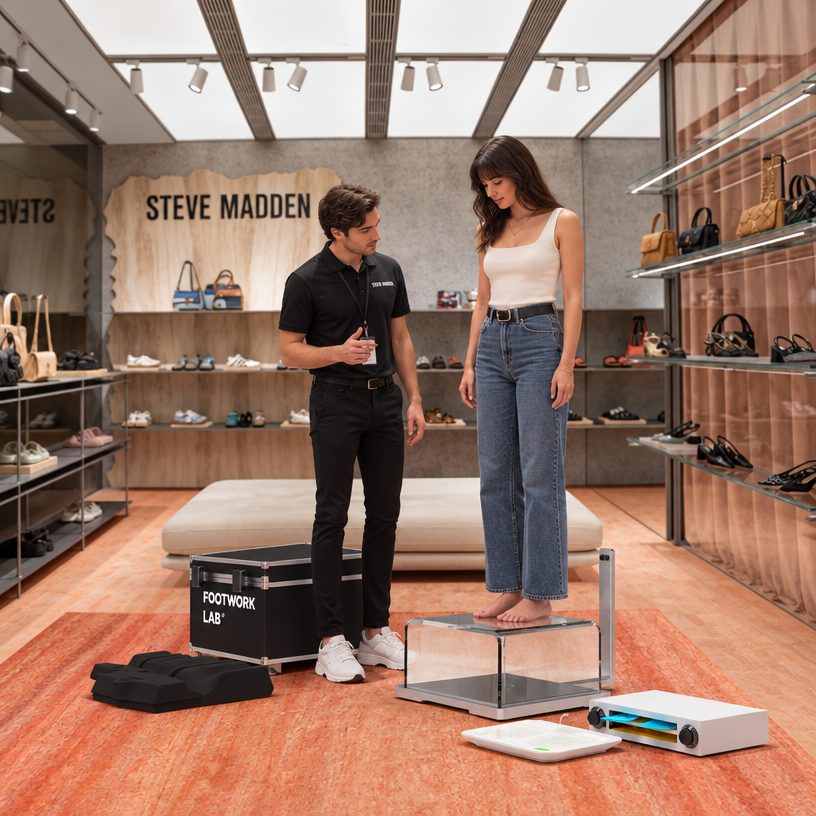
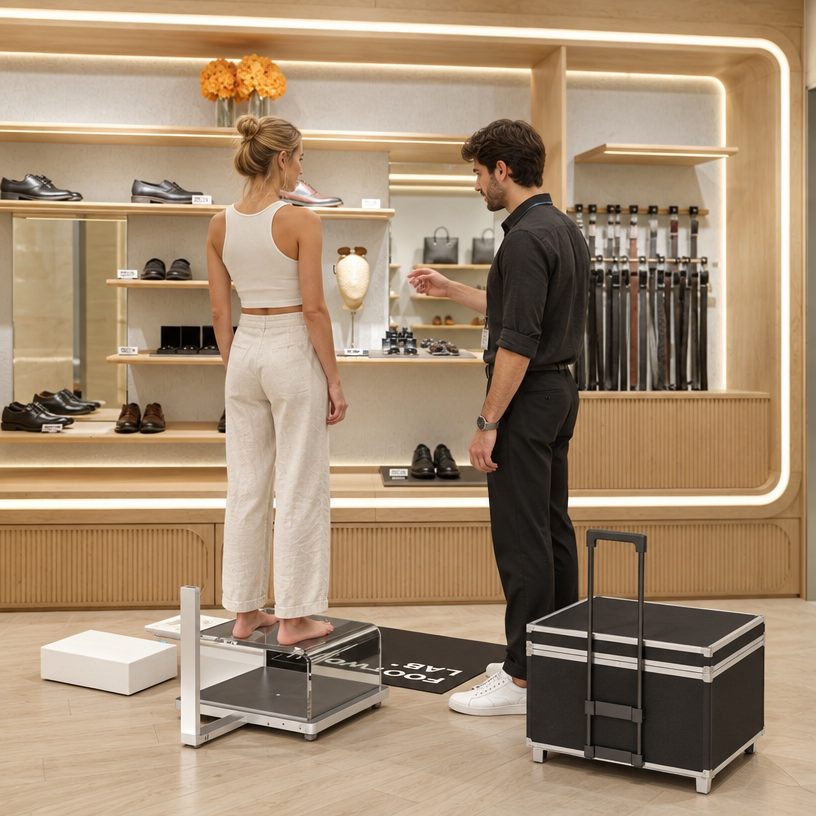
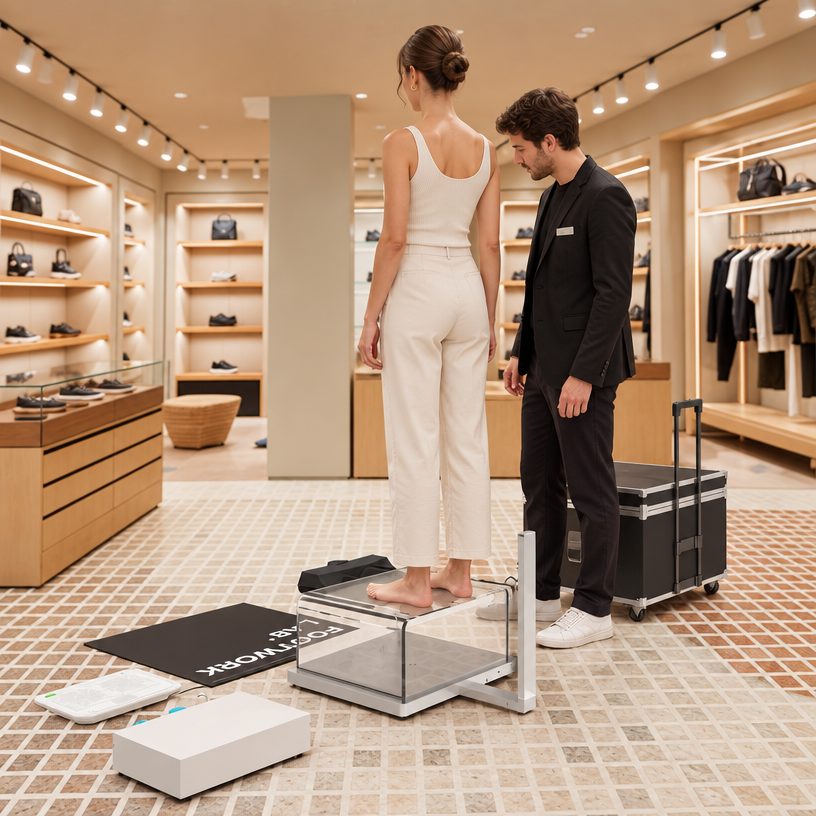
The quiet-standing moment itself deserves a breath of patience. Customers step on and immediately want to look at the screen — leaning, shifting, peering down at their own feet — and the first seconds of most first screens are the least steady seconds of the customer’s day. A room habit worth building: she settles, the staff member waits for the standing to still, then the capture is taken on purpose rather than caught in passing. A quick-screening plate such as the Q1P foot and leg quick-screening system makes the capture itself fast; the stillness before it is the part that stays human, and it is the part that decides whether the portrait describes her standing or her stepping-on.
And the screen has one more honesty rule that is easy to miss: the same conditions every time the room runs this screen, so that a first print taken today and a first print taken in six months describe comparable moments. Rooms that let the instruction drift — standing one day, half-leaning on a rail the next; barefoot today, socks tomorrow — accumulate portraits that cannot be compared and customers who notice the drift even when they cannot name it. The fix is the same discipline the rest of this series keeps returning to: decide the conditions in advance, write them down, and let the plate do what it does — record, faithfully, whichever moment it is given.
Where a first screen should lead
A first screen earns its place by leading somewhere, and the room should know where before the customer steps on. For some customers, the honest destination is reassurance by measurement: the portrait shows what she feared it would not show, the two feet are closer to twins than she expected, and the appointment’s value was the accurate frame it put around a worry she carried in without words. For others, the portrait is a starting point that justifies more: a fuller dynamic capture to see the foot at work, a conversation with the treating professional about what the whole picture suggests. Both destinations are legitimate. What a first screen cannot be is a terminus — a picture taken, nodded at, printed, filed.
The decision of which destination applies belongs to the qualified professional, reading record plus history together, and the staff member’s job at the screen is to know the fork exists, not to decide it. A simple two-line rule keeps new staff inside that boundary: the screen can raise questions and it cannot answer them; anything a customer hears at the plate must survive the sentence “this is a measurement, and the interpretation comes from the professional”. Staff who can repeat that sentence under pressure — after the third customer of a Saturday afternoon, to the one who arrived with an internet picture — are ready to run the screen alone.
Rooms that run first screens this way report a pattern worth ending on: the screen stops being the appointment’s weak moment and becomes its handshake. The customer got an honest portrait of her own standing, an accurate frame before her story formed, and a clear sense of what comes next and why — all inside the first two minutes. The rest of the appointment then runs downhill instead of uphill, because the hardest moment in foot screening, the one that decides whether the customer trusts everything after it, was handled deliberately rather than survived. That is the whole difference between owning a footprint plate and running a first screen.
Frequently asked questions
Is a darker patch on the footprint always a problem?
No. A darker area means more of the standing contact sat there at that moment — it is a description of how weight distributed, not a verdict. Some heavier-contact regions are ordinary, and what matters clinically, if anything, is a question for the qualified professional reading the whole picture. The accurate framing for customers is: darker means more, lighter means less, and neither word means better or worse.
Can a first footprint show why my feet hurt?
No. The print is a portrait of how weight sat during quiet standing at that moment. It does not show how the foot behaves walking, and it does not carry causes — the contact shape is a description, not an explanation. Connecting a measurement to a complaint is clinical interpretation, and that belongs to the qualified professional working from the history, the examination and the record together.
Does a flat-looking print mean flat feet?
The print records how much contact appeared during quiet standing, at that moment, under those conditions — nothing more. Turning that portrait into a label is interpretation, and interpretation belongs downstream of the measurement, with the professional. What the screen can honestly say: this is how your weight sat when you stood still today. What it cannot honestly say is what the foot is, in one word, from one still picture.
Should the first screen be taken barefoot?
Decide the conditions in advance and keep them the same every time the room runs the screen, because the image’s value depends on comparable conditions. Shoes off is the common choice for a standing portrait, but the rule that matters is consistency: barefoot today and barefoot in six months, same instruction, same position, noted on the record. A portrait taken under drifted conditions cannot be compared with anything, including itself.
Why does my footprint look different from last time?
Small differences between portraits are ordinary, because standing is not a frozen posture — day to day, and even minute to minute, weight settles differently. What matters is whether the differences are scattered and local, which is normal variability, or whether conditions changed between the two captures: instruction, footwear, position. The conditions written on the record answer that question, which is why rooms that skip the conditions line end up explaining differences that were documented all along.
What should new staff never say when handing over the print?
Three categories: diagnostic naming (“this shows you have”), promises downstream (“this will make it feel better”), and explanations the plate cannot license (“that is why it hurts”). None of these is supported by a static portrait, and each converts the measurement into a verdict the moment was never designed to deliver. The safe handover stays inside: what was measured, in portrait language, plus where the interpretation actually happens.
Does a first screen replace a full assessment?
No, and rooms that let the boundary blur end up over-reading the under-reading. The screen is a portrait of standing; the fuller assessment captures how the foot works in motion and puts the measurement beside a proper history. The screen’s honest role is to start the conversation accurately and, where the professional judges it useful, lead to the fuller capture — a handshake, not the whole appointment.
What we would do next
Write the three-sentence handover onto a card and tape it at the plate’s workstation, then have every member of staff — not only the new ones — deliver it to a colleague playing a first-time customer until the sentences come out unchanged. Then audit the room’s conditions: same instruction, same position, same footwear rule, written on every record, so that today’s portrait and next quarter’s are describing comparable moments. Rooms that fix the handover and the conditions together find the same plate producing files that read clearly a year later — and for the close cousin of this problem, reading posture from the side as well as from below, see Standing Sideways: The View a Pressure Map Cannot Give You.
And the question we would put to every room that runs first screens: play back the last ten handovers in your head — how many described a portrait, and how many quietly delivered a verdict nobody had authorised?
This article is intended for professional and educational reference. It is not medical advice. Foot assessment equipment produces measurements and images; clinical interpretation and any decision about care remain the responsibility of a qualified professional. Certification scope is limited to the documentation we hold: European Union certification and ISO quality system certification.