
A foot scanner can record posture without understanding it, and that gap
is where a clinic has to be careful. When a foot-assessment platform is used alongside
posture observation, what it produces is a record: how a person stands, where their weight settles
over the feet, and how the lower limb lines up in that position. What it does not produce is an
explanation of why the posture looks the way it does, or what it means for the person in front of
you.
This is an argument about boundaries rather than capability. A camera-based system that records
standing position is genuinely useful — it makes something repeatable that is otherwise described
from memory, and it gives a customer or patient something concrete to look at. But the moment a
record is presented as a finding, the tool has been asked to do a job that belongs to a trained
professional. The sections below set out what a 3d posture analysis workflow captures, what it
leaves out, and how to keep the two from being confused in front of a customer.
What posture capture means in a foot-assessment setting
In this context, posture capture is not a whole-body medical examination. It is the observation
and recording of how a person’s body is arranged while standing, seen from the perspective of the
feet and the lower limbs. The equipment contributes an image or a set of measurements; the
observation contributes a description.
Most systems in this category do one or more of the following:
- A standing record — capturing the position of the person while still, including
how weight appears to be distributed over each foot. - A centre-of-gravity reference — showing where the body’s mass appears to
project relative to the base of support formed by the feet. - A lower-limb alignment record — imaging the leg and ankle position to describe
force-line alignment relative to the foot. - A footprint or contour record — showing the arch profile and contact area from
below.
What all of these share is that they describe a position. They do not, in themselves, say whether
that position is a problem, a normal variation, or a compensation for something happening elsewhere.
That judgement is separate from the recording, and it is the part that requires a trained eye.
The division between recording and judging is the through-line of this whole area, and it is worth
stating once clearly: the system observes and stores, the professional reads and decides. Everything
the equipment does sits in service of the first half of that sentence, and nothing it does amounts
to the second.
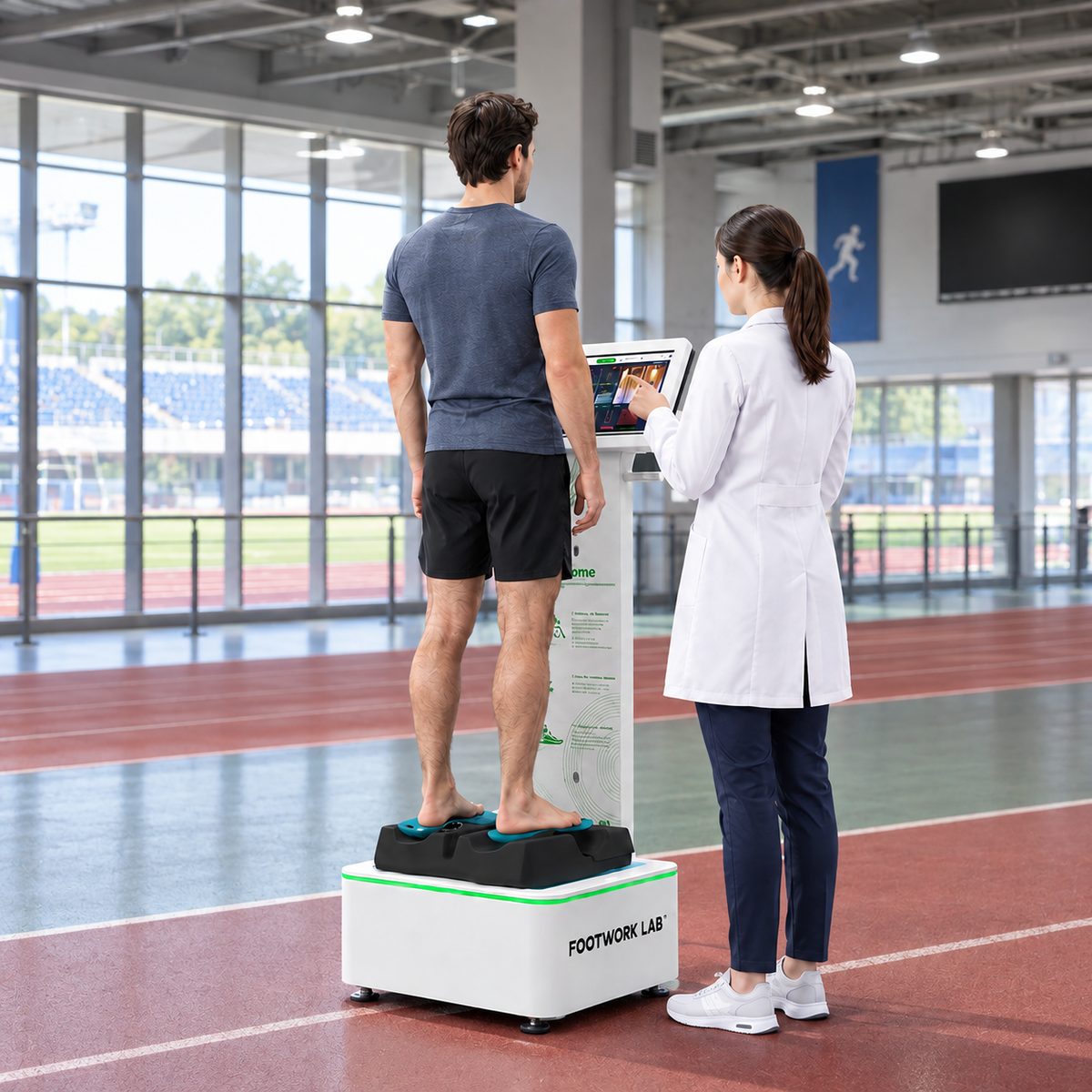
Standing still: where the weight settles over the feet
The simplest posture record is the standing one. The person stands as they normally would, the
system captures the position, and the result shows how the body’s mass appears to sit over the base
of support. Two ideas matter here: projection and distribution.
Projection is the question of where the body’s centre appears to fall relative to the feet. If
that reference sits toward one side or toward the front or back of the base of support, the record
will show it. Distribution is the related question of how load appears to be shared between the two
feet and across each foot.
Both are static observations. They describe a moment of stillness, and stillness is a special
case: most of the day is spent moving, and a person who stands still while being recorded is
standing in a way they may not hold naturally. That does not make a static record worthless — it is
quick, repeatable and easy to explain — but it is one frame, not the whole film.
A useful habit is to use the standing record as a baseline rather than as a result. It is where
a conversation starts, not where it ends, and comparing two baselines taken months apart is often
more informative than reading either one alone.
It is also worth asking what the person was doing immediately before the capture. Standing after a
period of sitting, standing after walking, standing in shoes or standing barefoot each give a
slightly different picture, and the same person can look noticeably different across two recordings
taken minutes apart. Consistency in how the capture is set up does more for the usefulness of the
record than any additional feature. A standing record is also easy to explain, which is not a trivial
point in a clinic or a store: a customer who can see their own footprint and their own balance point
understands what is being discussed far faster than one listening to a verbal description.
Lower-limb alignment and the force line
Where a system records the leg and ankle as well as the foot, the observation extends upward from
the sole. Force-line alignment describes the direction in which load is transmitted through the
lower limb relative to the position of the foot beneath it. Recorded as an image, it gives a
visual reference for something that is otherwise hard to describe consistently.
Recording that alignment adds context a footprint alone cannot carry. A contact pattern that looks
unusual from below may make more sense once the limb position above it is visible, and a limb
position that looks notable may be unremarkable once the foot beneath it is taken into account.
Reading the two together is more informative than reading either in isolation.
What an alignment record is not is a verdict. It shows a position at a moment in time. It does
not show how the person moved to arrive at that position, how much of it is habitual, or how much of
it is comfortable for them. Those questions are answered by watching the person walk, asking them
questions and applying professional judgement — none of which the camera does.
It is also worth remembering that alignment varies. People stand differently when tired, when
shifting weight, when wearing different footwear, or simply when they know they are being observed.
A single image is a snapshot, and snapshots need care.
Because the record is an image, it also invites over-reading. A camera sees the outside of the
limb, which means it records the position of the leg as it appears — not the position of the joints
inside it, and not the state of the tissue around them. Two people can stand with a similar-looking
alignment and have quite different underlying situations, and the reverse is equally true.
An image record is not an interpretation
The most common misuse of posture capture is also the simplest to avoid: treating the picture as
if it were the answer. A camera can show that a person’s weight appeared to sit more toward one side
during a recording. It cannot show whether that matters, whether it is stable, or what caused it.
This is the same boundary that runs through all foot-assessment equipment. A device produces a
record; interpretation belongs to a qualified professional. The record makes a conversation
concrete and comparable, which is its real value — it lets “your posture looks a little off” become
“here is what we recorded today, and here is what we recorded last time.”
That is a substantial improvement over memory and description. It is not a substitute for
judgement, and presenting it as one is where clinics get into difficulty — with a customer, and
sometimes with themselves.
We build and describe our systems as recording tools for this reason. The X5 and the rest of our
foot-scanner range produce measurements and images. Clinical interpretation and any decision about
care remain with the qualified professional using them.
A parallel in everyday terms: a photograph of a person standing tells you how they stood for that
photograph. It does not tell you how they usually stand, whether they were comfortable, or whether
the pose was natural. A posture record is more structured than a photograph, and more comparable
across visits, but it shares the same essential quality — it is a record of an appearance at a
moment, and appearance is one input among several.
What the machine cannot see
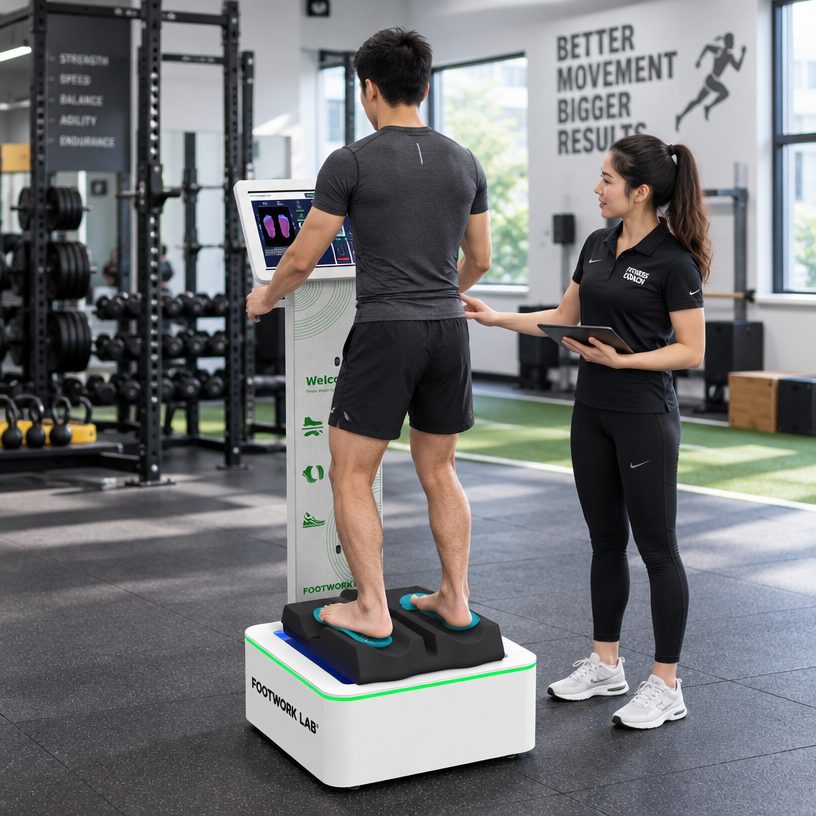
The limits of a posture record are worth stating plainly, because they shape how it should be
used. A foot-and-lower-limb capture system does not see:
- Soft tissue. Muscle condition, ligament behaviour and joint mobility are not
what a position camera is built to record. - The source of anything a person reports. What someone says about how they feel
is history, and history comes from the person, not from the recording. - Movement over time. A static record describes a moment; it does not describe
how the body behaves in motion, which is often the more informative picture. - Anything above the recording frame. What sits outside the field of capture is
simply not in the image.
A record that shows one thing and leaves out four others is not a bad record — it is a partial
one, and partial records are useful when everybody knows which part they are looking at. The
trouble starts when a partial record is presented as a whole one.
The practical safeguard is to describe the record in the language of measurement: “this is where
your weight appeared to sit today” rather than “this is what is wrong with you.” The first invites a
professional conversation; the second makes a promise the equipment cannot keep.
There is also a commercial dimension to this boundary. Equipment sold as a recorder is equipment a
clinic can rely on; equipment oversold as a decision-maker creates expectations the hardware cannot
meet, and the disappointment that follows lands on tools that are working exactly as intended. We
would rather set the expectation honestly at the point of sale than defend it afterwards.
Fitting posture capture into a working clinic or store
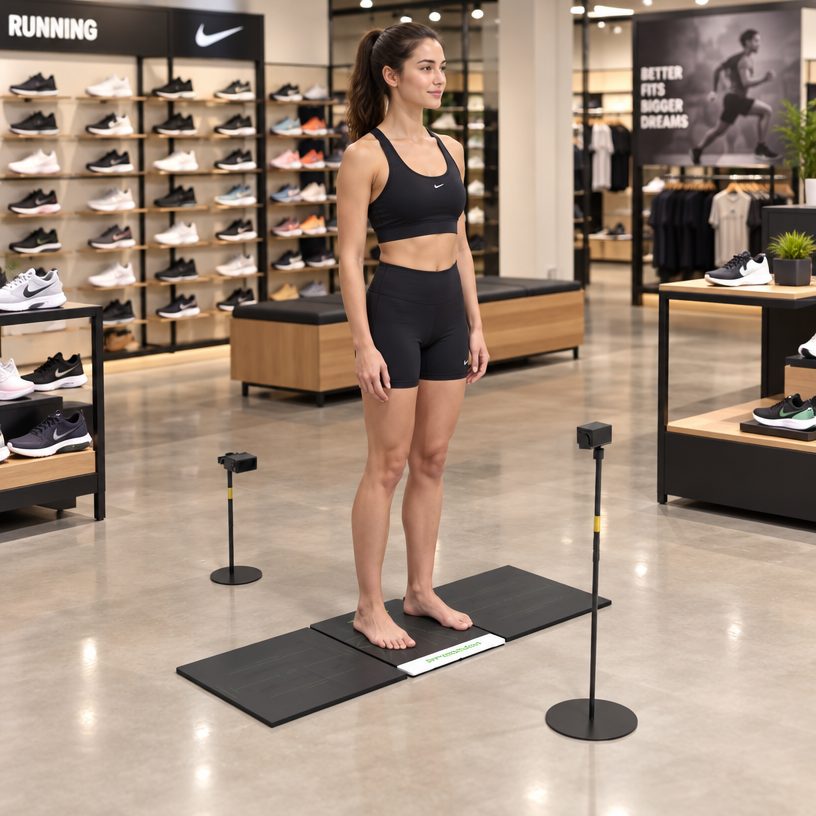
In daily use the recording step is short, and that is the point. A standing capture takes minutes
including setup, which means it fits inside a normal appointment or a retail conversation rather
than dominating it. The workflow questions that matter are usually logistical rather than technical:
where the platform sits, who runs the capture, and where the record goes afterwards.
Space and staffing are usually the deciding factors. A capture station needs somewhere a person can
stand comfortably and be seen clearly, and it needs one member of staff who owns the process —
someone who knows how to set it up the same way each time and what to say while it runs. Where those
two things are settled, the recording becomes routine; where they are not, it becomes an occasional
novelty that quietly falls out of use. Where the record goes is the part most often left undecided,
and a capture that produces an image nobody can find again, or that lives only on one workstation,
gives little value over time. Deciding the storage and naming convention before the first session is
what makes the second session useful.
On our side, the practical commitments concern the instrument rather than any promised outcome.
Every unit runs through a seven-day test cycle before dispatch, and the machines use a modular design
so that parts can be replaced individually. The software includes remote-control functionality, so an
engineer can help from a photograph, a video or, with consent, a remote session, and where a machine
is connected to the internet, updates can be pushed over the air. Each customer has an after-sales
group with our engineer in it.
Those details matter for a posture workflow because a record is only useful if it can be produced
reliably, session after session, for years. A capture that depends on a piece of hardware nobody can
service is a capture a clinic will quietly stop using.
Training is usually minimal, but it should be deliberate. Whoever runs the capture needs to know
how to position the person, how to keep the setup the same between sessions, and how to describe
what the record shows without drifting into a conclusion. In a retail setting that last point
matters most, because the person on the other side of the counter will hear any confident statement
as a verdict about their body. Keeping the language at the level of what was recorded keeps the
conversation useful, and it keeps the tool doing the job it was actually built for.
Frequently asked questions
What does 3d posture analysis actually record?
In this setting it records how a person is arranged while standing, seen from the feet and lower
limbs: a standing position, where the body’s mass appears to project over the base of support, the
alignment of the leg and ankle relative to the foot, and the arch profile from below. The output is
an image or a set of measurements — a record, not a conclusion.
Can the system tell me what is causing someone’s posture?
No. A recording shows a position at a moment in time. It cannot establish why the body is
arranged that way, whether the position is significant, or what should follow. Interpretation and
any decision about care remain with a qualified professional.
Is a static standing record enough to describe posture?
It is a useful baseline, and it is quick and repeatable, but it describes a single moment of
stillness. How the body behaves in motion is a different question and needs a different kind of
record. Static and dynamic captures are complementary rather than interchangeable.
Does the equipment replace a professional assessment?
No. It makes part of the observation repeatable and easy to show, which is genuinely useful, but
it does not replace assessment. The record supports a conversation with a qualified professional; it
does not stand in for one.
Can the recording software be customised?
Yes. Because we develop our software ourselves, custom report fields and interface changes are
possible. These are quoted separately, since the scope varies substantially between projects.
How is the equipment tested and supported after delivery?
Every unit runs through a seven-day test period before dispatch and carries a twelve-month
warranty covering non-human-caused failures. The modular design and remote-control functionality mean
many issues can be worked through from photographs, video or a remote session with consent, and each
customer has an after-sales group with our engineer in it.
What should a clinic avoid saying about a posture record?
Avoid presenting the record as a finding or a diagnosis. Describe it in the language of
measurement — what was recorded today, and how it compares with last time — and let the qualified
professional draw the conclusions.
What we would do next
If posture capture is part of what your setting wants to offer, decide first what you will do
with the record once you have it. A clinic that plans to compare standing records across visits
needs a different setup from a store that wants a single image to support a conversation, and both
are valid starting points.
Our own product details are on the X5 foot scanner page, and we
have written separately about foot scanning in the clinic and about
podoscope-based foot analysis. If you describe your setting and the
questions you want the record to answer, we will tell you which configuration fits and which parts
of our range you do not need. The FAQ covers commercial and service terms in
detail, and the contact page reaches our team directly.
This article is intended for professional and educational reference. It is
not medical advice. Foot assessment equipment produces measurements and images; clinical
interpretation and any decision about care remain the responsibility of a qualified professional.
Certification scope is limited to the documentation we hold: European Union certification and ISO
quality system certification.