
The customer stepped off the plate, leaned towards the glass and pointed at her own footprint before anyone had said a word: is that really my right foot? That question is the reason many rooms keep a glass plate beside the pressure platform even after the platform has arrived and been set up. A screen full of pressure colours answers questions the customer did not ask; a footprint on glass answers the one they do ask, in their own shape, in front of their own eyes. The plate turns a consultation from a demonstration into a conversation, and the conversation is where a customer decides to take the recommendation seriously, book the instrumented session and come back for the second visit. Used well, a plate session takes a few minutes and does work no printed report can. Used carelessly, it tempts the operator to say more than a wet footprint can support, and the overstatement gets repeated in the room long after. This article works through the first version: how experienced rooms run the demonstration, the lines they use while the customer is looking at the glass, where the print stops and the instrumented record has to take over, and what gets written down so the teaching moment survives in the folder as more than a memory.
Why the glass still earns its place
A pressure report is accurate, layered and, to most customers, unreadable. The colours mean something to the professional and very little to the person looking over the counter at them. A footprint on glass works in the opposite direction: it is unmistakably the customer’s own foot, the outline is familiar, and the difference between the two feet is visible without any explanation at all. Nobody argues with their own footprint. That recognition does what a paragraph of explanation cannot: it moves the customer from being shown a result to looking at their own body and asking about it.
The plate also slows the consultation down in a useful way. Standing on glass, stepping off, turning around and looking takes half a minute, and in that half minute the customer stops performing a task and starts observing. Rooms that go straight to the platform often spend the first captures managing a customer who does not yet know what is being looked for. The plate, run first, answers that in advance, and the instrumented session that follows is calmer for it.
There is a practical point too. The plate needs no software, no calibration conversation and no file format decision. It occupies a quiet corner of the room, it works during a busy afternoon, and it never refuses to start because of an update. That is exactly why it survives in rooms that own far more expensive equipment: it is the one instrument in the practice whose whole output is something the customer instantly understands.
How the demonstration actually runs
The script is short. The operator wets the sole, or the customer does, and says: step up, stand the way you normally stand, and step down. Both feet together first, then each foot on its own, then, if the room works that way, one more pass so the customer can watch their own feet come away marked on the glass. The whole demonstration takes less time than finding the customer’s file, and it should be allowed to stay that short.
What the operator says while the customer looks is where the teaching happens, and the working rooms keep it to naming. This darker area is where your foot touches the glass; this lighter edge is where it presses less; here the two feet do not look quite the same. Naming what is on the glass, without yet saying what it means, keeps the operator honest and keeps the customer curious. The verdict comes later, if it comes at all, and it comes from the full assessment rather than from a wet mark.
Beside the plate there is usually a paper sheet, and the sheet gets two lines: the date, and what the customer asked when they saw the print. That second line matters more than it looks. The question the customer asked on the spot is the best guide to what the instrumented session should be arranged to answer, and it is exactly the kind of detail that never survives to the end of a busy day unless somebody writes it down while the customer is still in the room.
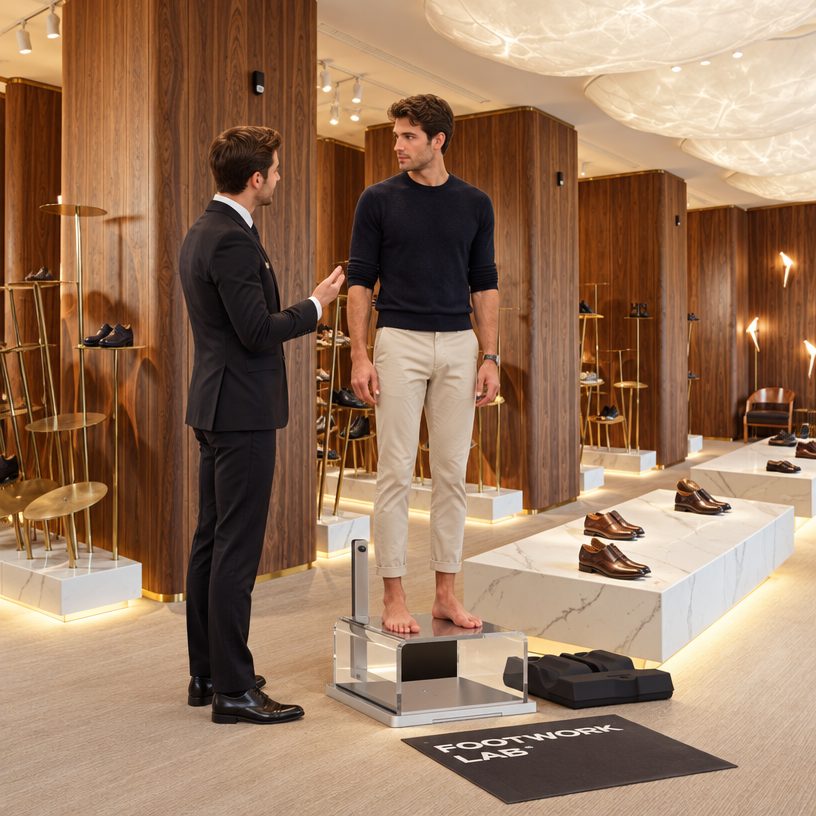
What the print shows, and where it stops
A footprint on glass shows contact at rest: the outline of the foot under body weight, how the forefoot presents, how the heel presents, how the midfoot region reads between them, and, when both feet are taken on the plate, the differences between left and right side by side, in the customer’s own proportions. For opening a conversation about a foot, that is a lot of honest material, and none of it requires the customer to read a chart.
What it does not show is just as important to state out loud. It is one instant of quiet standing, not a walk. It says nothing about how load arrives through the step, about timing, about how the foot behaves after an hour of work or at the end of a shift. The wet film has habits of its own as well: too much water and the print smears, reading wider than the contact really is, which is why experienced operators re-run a smeared print rather than explain it away.
The sentence that keeps the room honest is one many operators use almost word for word: this is how your foot sits when you stand still; it does not tell us how you walk. That sentence hands the customer to the next stage of the assessment instead of pretending the plate has already answered everything. A footprint is a measurement of contact under stated conditions. What it means for this particular customer is interpretation, and interpretation belongs to the qualified professional working from the fuller record.
Turning the print into a conversation, not a verdict
The difference between teaching and concluding is easy to hear in the operator’s phrasing. That is your weak arch is a verdict, delivered in five words, and the customer carries it out of the room as a fact about their body. Here the contact looks wider than on the other side, and it is worth a proper look is an observation with a next step attached. The first version ends the conversation; the second one books an appointment. Rooms with strong return rates are, almost without exception, rooms in the second habit.
The most effective rooms hand the comparison to the customer. Which foot looks different to you? Customers see it immediately, usually before the operator would have pointed at it, and something a person noticed themselves is remembered far longer than something they were told. The operator’s job then is gentle correction and direction: yes, and here is what we will look at properly when we do the full session. Nothing is confirmed at the glass; everything is scheduled.
Run this way, the plate sets the agenda for the instrumented session instead of replacing it. The customer’s own observation becomes the thing the pressure record is arranged to answer. Our piece on building a left-and-right comparison you can defend covers how that comparison is carried through onto the platform, where the same two feet can be put under measurement rather than under impression, and where the differences get numbers instead of adjectives.
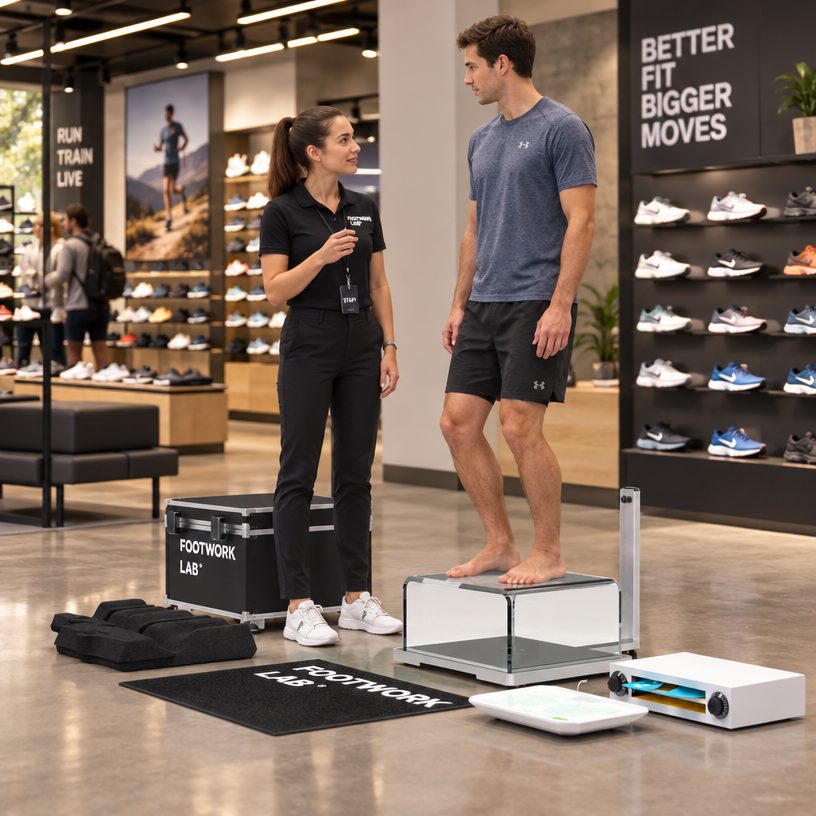
A static print and a dynamic record answer different questions
The plate and the platform are not two grades of the same thing. The glass answers a shape-and-contact question at rest: what the foot presents under body weight in one quiet moment. The platform answers a load-and-time question in motion: how force arrives under the foot through the stance phase and the gait cycle, where the peaks sit, and how the two sides compare across full steps. Static and dynamic describe genuinely different behaviour, and a room that keeps the two distinct can explain to a customer exactly why both parts of the visit exist.
Pairing them in this order also improves the captures themselves. A customer who has already stood on glass, seen their own footprint and heard what will be looked at next steps onto the platform knowing what the session is for, and settles noticeably faster. A good share of the restless first captures that fill so many folders belong to customers who were never told what was being looked for, and the plate removes that particular silence.
The report the platform produces carries numbers the plate cannot offer: how pressure peaks, how contact spreads across area, how each region is loaded over time. Our article on the three numbers that head most pressure reports walks through them in order. The print has none of those numbers, and that is precisely the division of work between the two: the plate gives the customer a picture they recognise, and the record gives the professional something to measure against at the next visit.
Where the plate is the wrong tool
There are questions the glass cannot take, and a room that knows them keeps itself out of trouble. Anything about movement belongs to the platform: how the foot rolls through the step, whether load moves where it should, what the foot does after a long day on concrete. Timing, force and fatigue are dynamic questions, and a static print answers none of them, however confidently it is described. The operator who catches themselves explaining walking from a standing print has drifted past the edge of the tool.
There is also variability to respect. The same foot, printed three times across one working day, does not produce three identical prints, and the same foot measured at three points in a day does not produce three identical instrumented records either, as our walkthrough of one foot measured across a working day sets out. Time on the feet, temperature and how recently the customer walked all leave their mark. The operator who notices this month’s print looks different from last year’s has several honest explanations to consider before concluding that the foot itself changed.
A printed footprint does hold one advantage worth naming to buyers who assume otherwise: it can be compared, kept and photographed, and it shows the customer’s foot with no software between them and it. Our longer piece on what a printed footprint on glass still shows that a screen does not covers that ground properly. But the plate remains a measurement aid inside the consultation. It is not a diagnostic instrument, and the room that treats it as one will eventually say something the wet film never supported.
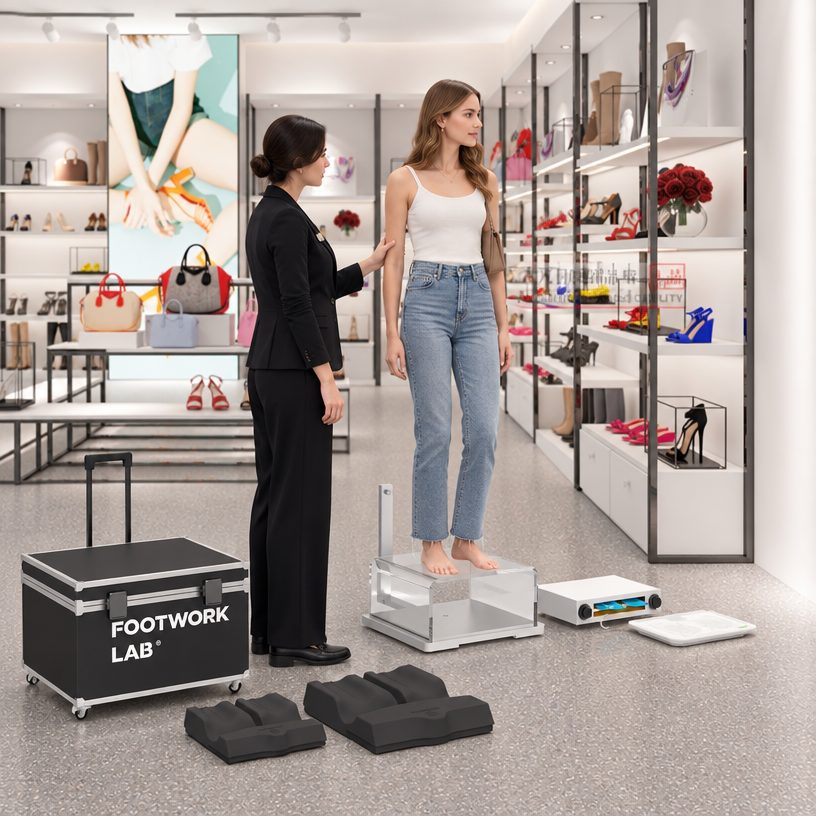
Keeping the teaching moment in the folder
The demonstration is over in minutes, and unless something is written down it leaves no trace. Rooms that get repeat value from the plate do three small things: they note on the session sheet that a plate demonstration was taken and what the customer asked; they photograph the print with the customer’s agreement; and they date it like any other record. None of the three takes a minute, and together they turn a moment into a record.
The photograph is the part that earns its keep later. A customer who returns next season, or whose footwear has changed, can be shown the earlier print beside the new one, taken the same way, and the conversation starts from comparison instead of recollection. That only works if the method was the same on both days and the method was written down, which is the same discipline that keeps pressure records comparable from one visit to the next.
The script belongs in writing too. The lines the room uses at the glass — the naming, the no-verdict phrasing, the sentence about what the print does not show — should sit next to the protocol in the same handwriting as everything else, so that new staff inherit the tone and busy afternoons do not erode it. Rooms that treat the demonstration as part of the protocol rather than as individual charm keep their consultations consistent through staff changes, and their customers hear the same honest version of the footprint every time they visit.
Frequently asked questions
Does a footprint on glass show enough to explain anything to a customer?
For one purpose, yes: it shows contact at rest in a shape the customer recognises immediately. The outline, forefoot and heel contact and left-versus-right differences are all visible without explanation. It does not show how load moves through a step, which is what the pressure platform is for. As a teaching aid in the first minutes of a consultation it does more than any paragraph of text.
Can you tell a customer’s arch type from a wet footprint?
The print shows how the midfoot region presents under body weight at rest, which is honest material for a conversation. It is not a classification on its own: the film, the load and the moment all influence what appears. Rooms that avoid verdicts at the glass and carry the question into the instrumented session keep the consultation honest and the interpretation where it belongs.
How long should a plate demonstration take?
A few minutes. Wet the sole, both feet together, then each foot alone, then let the customer look and ask. Two lines go on the session sheet afterwards. If it is turning into a long explanation, the operator has drifted from naming what is on the glass to interpreting it, and the full assessment should take over from there.
Should both feet be shown together or one at a time?
Both together first, because the side-by-side difference is what customers notice and remember, then each foot on its own for a cleaner look at one print. The comparison the customer makes themselves is the most useful teaching moment the plate offers, and it sets up the left-and-right comparison in the instrumented record later.
Is it worth photographing the print?
Yes, with the customer’s agreement, and date it like any other record. A photograph taken the same way on a later visit gives the room and the customer a before-and-after comparison of contact at rest. It only works as a comparison if the method was the same on both days and that method is written down on the session sheet.
Why does the print sometimes look smeared or wider than the foot?
Almost always the wet film: too much water spreads the mark beyond true contact. Re-wet sparingly and take the print again rather than explaining the smear away. A re-run takes seconds and keeps the demonstration honest; a smeared print quietly overstates contact and can mislead the whole conversation that follows it.
Does the glass plate replace the pressure platform?
No. The plate answers a static contact question in a shape the customer recognises; the platform measures how load arrives and distributes through walking. Rooms that keep both use the plate to open the consultation and the platform to answer the question it raises. Neither replaces the interpretation of a qualified professional.
What we would do next
Put the plate script into the room this week: the naming lines, the no-verdict rule, and the two-line note on the session sheet. Then check the last ten folders for whether plate demonstrations were recorded at all; where they were not, start now rather than trying to reconstruct old visits. The Q1P foot and leg quick-screening system page describes how the plate sits inside a quick-screening workflow for the front of the room, and our piece on what a printed footprint on glass still shows that a screen does not takes the comparison with the screen further. The FAQ page carries the operational answers we give most often by message, and if you are equipping a new room, the contact page reaches the factory directly rather than a middleman.
This article is intended for professional and educational reference. It is not medical advice. Foot assessment equipment produces measurements and images; clinical interpretation and any decision about care remain the responsibility of a qualified professional. Certification scope is limited to the documentation we hold: European Union certification and ISO quality system certification.