
The customer takes her shoes off, and behind her the daughter pulls up a chair, the son-in-law settles by the door, and the grandson lifts a phone pointed at the screen. Nobody in the room has done anything wrong. The family came because they care, and in many clinics and fitting rooms this is not the exception but the ordinary shape of an afternoon. Yet anyone who has run sessions for a while knows the difference between a record taken with one person watching and one taken with four: the questions get answered by somebody else, the quiet shrinks, and the walk itself acquires an audience it did not have when the appointment was booked. This article is for the professionals who work in that fuller room. It is about what the extra people do to a session — to the conversation, the calm, the crossing and the paperwork — and about a handful of small, repeatable moves that let the family stay, the record stay honest, and the appointment still finish on time.
The room changes shape before anyone says a word
The booking said one appointment. The arrival brings three or four people, and within a minute of everyone being inside, roles have formed without a word being exchanged. Somebody has become the spokesperson, the one who fields questions on behalf of the room. Somebody has become the historian, carrying years of remembered appointments in their head. Somebody is filming. And one person — usually the customer — is trying to be a patient in the middle of all of it.
The arithmetic of attention shifts the moment this happens. The customer is no longer only being assessed; she is also managing her family’s expectations, keeping an eye on the grandson, and wondering whether her daughter will contradict her. The operator is no longer only attending to the customer; a share of the working attention now belongs to keeping the room comfortable. Nothing dramatic is happening, but the session is running on more channels than it was designed for, and every one of those channels costs something.
The first useful move is attitudinal, and it costs nothing: treat the family as a condition of the session rather than an obstruction in it. They will usually still be there years after the record is filed, and they notice how they were handled. The practical question is not how to empty the room but how to run a good session inside it — and the sections below are all versions of that question.
Who answers the questions, and what it costs the record
The most common pattern in a full room is also the easiest to miss: you ask the customer a question, and a family member answers first. It happens for kind reasons. The daughter is quicker, more fluent in the vocabulary, more confident, and has heard the story before. The customer, relieved not to have to summarise herself, lets the answer stand. Two sessions later nobody remembers that the intake conversation stopped being the customer’s own somewhere around the second question.
Why it matters: a record should carry the customer’s own words wherever it can. Second-hand summaries compress complicated histories into single confident sentences, and details get flattened in the retelling — the ache that comes and goes becomes “she has trouble with her feet”, which is a different sentence with less information in it. The person who will interpret the record later deserves the version told by the person who lives in the feet.
The redirect is simple and worth rehearsing. Ask the question, direct it to the customer by name, and then wait — a genuinely patient wait, longer than feels natural, because the family member needs a beat to realise the silence is not an invitation. If the family adds to an answer the customer has given, take it, but label it on the sheet as their report, distinct from the customer’s own account. Both belong in the file. Blended together, neither does.
The phone at the screen is not the problem
Sooner or later a phone comes out. A grandson films the screen as the record appears, or a daughter photographs the pattern because she wants to remember it and show her sister. The instinct in many rooms is to stop it. The better instinct is to read it first: filming is usually reassurance. The family wants proof of thoroughness, a thing to carry home, a way of participating in what feels like an important event. Forbidding it converts a caring gesture into a small conflict, and the customer stands in the middle of that conflict.
Handle it practically instead. A phone held at the screen can block a sightline or distract during the walk itself, so the useful sentence is about position and timing, not permission: “Happy for you to film the record once it’s done — during the walk we keep the room as ordinary as possible.” Most families accept this instantly, because what they wanted was the record, not the disruption. If your practice has a channel for sending results to the customer afterwards, say so; once the family knows a proper copy will reach them, the phone often lowers on its own.
What filming genuinely does change is the customer’s sense of an audience that will watch the walk again at home. A walk being recorded for the file is a walk; a walk being recorded for the family group chat can start to feel like a performance, and performances are the subject of the next section.
Walking for an audience
People walk differently when they are watched, and the difference has a shape worth knowing: strides lengthen or slow, posture over-straightens, the whole crossing becomes slightly more deliberate than the one the customer would make on her own pavement at home. A single observer produces a measurable effect; a full room of relatives, one of whom is filming, produces more of it. And the ordinary walk — the one the record exists to capture — is precisely the one that tends to disappear under observation.
The family’s presence raises the stakes on top of this. Customers want to walk well for the people who came with them; “do it properly” is a feeling the room generates without anyone saying it. Three practical counters work together. Give the family a job — the coats, the grandson, the paperwork at the desk — so their attention has somewhere settled to rest. Keep talking in your ordinary working voice through the walk, because a normal conversation tells the customer that this is a normal event. And take more passes than a quiet-room session would need, because the first crossing usually carries the performance and the ordinary walk surfaces two or three crossings later.
The operator’s read comes from watching the sequence: the first pass, careful and presentational; the later ones, increasingly unremarkable — which is to say, increasingly useful. Note on the sheet which pass will serve as the reference. The choice is yours to make; leaving it undocumented leaves the next reader guessing.
A thirty-second script for the greeting
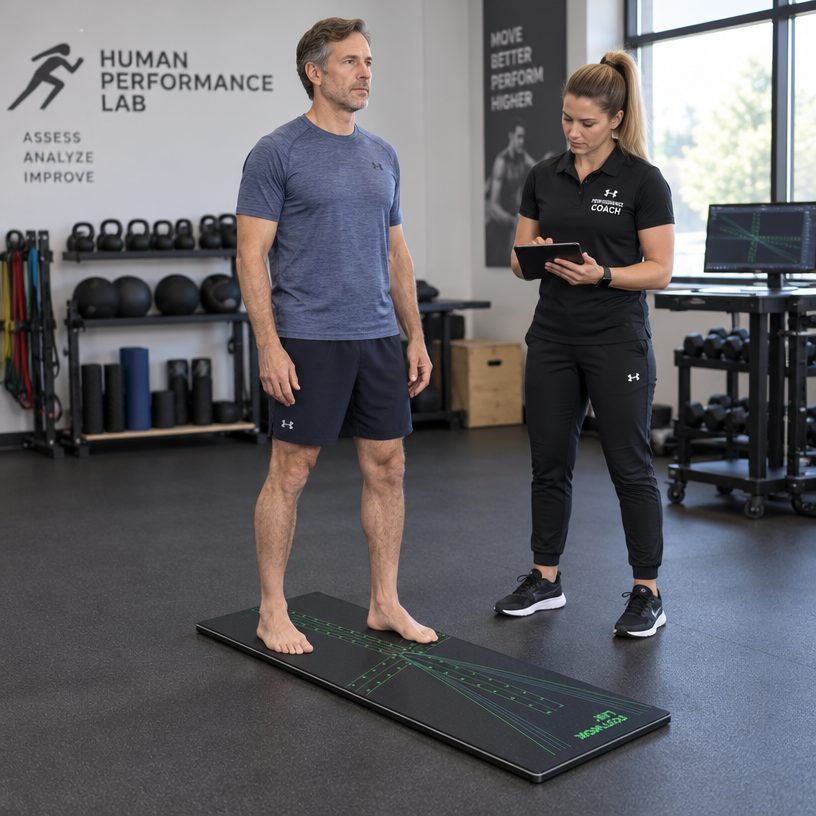
Most of what goes wrong in a full room can be prevented in the first thirty seconds, before roles harden and habits set. The script has four beats, and it works best delivered in the same order every time. Beat one: greet the customer first, by name, and hand her the session — a handshake that goes to the daughter first quietly transfers ownership of the appointment to the daughter, and the rest of the session follows that early signal.
Beat two: one sentence to the family that sets the shape of the room. “We’ll ask Margaret the questions as we go, and afterwards there’s time for anything you’d like to add.” It is warm, it promises them a turn, and it establishes who answers during the walk. Beat three: give the family a role, however small — the coats, the grandson’s coat, the forms at the desk. A family with a task is a settled family. Beat four: state the filming habit plainly and kindly, as in the previous section, so the phone question is resolved before it arises.
Write the four beats on a card and keep it where the greeting happens. The point of a script is not flat, mechanical delivery; it is that the same welcome happens on the busy Thursday as on the quiet Monday, and the customer meets the same session whoever is standing in the room with her. Practices that improvise the greeting will find the room sets the tone instead — and the room, four people strong, sets a louder one.
What belongs on the sheet when the room is full
A record taken in a fuller room is a record with conditions, exactly like one taken early on a cold morning, and the conditions belong on the paper next to it. Three lines carry most of the weight. Line one: who was present — “daughter and grandson, daughter answered intake questions” is a complete entry. Line two: what the family volunteered, written as their report and labelled as such: “daughter reports her mother slows noticeably by late afternoon.” Line three: which pass was taken as the reference, and whether the room settled over the session the way the previous section describes.
These lines exist for the next reader of the file — a colleague, a referrer, or you in three months. “Quiet heel loading” means one thing on its own and a better-defined thing beside “record taken in a full room, fourth pass used, customer’s own account used for intake.” The pattern did not change between those readings; the weight a careful reader should give it did. Documentation is how that weight travels with the measurement instead of being reinvented, or lost, by whoever opens the file.
One boundary holds throughout: family observations are descriptions, not findings. Write what they said, in their words, under their name as the source — and leave every conclusion to the qualified professional who reads the whole file. The same discipline that governs the machine’s output governs the family’s report: both are material, and neither is a diagnosis.
When the family is the reason the session exists
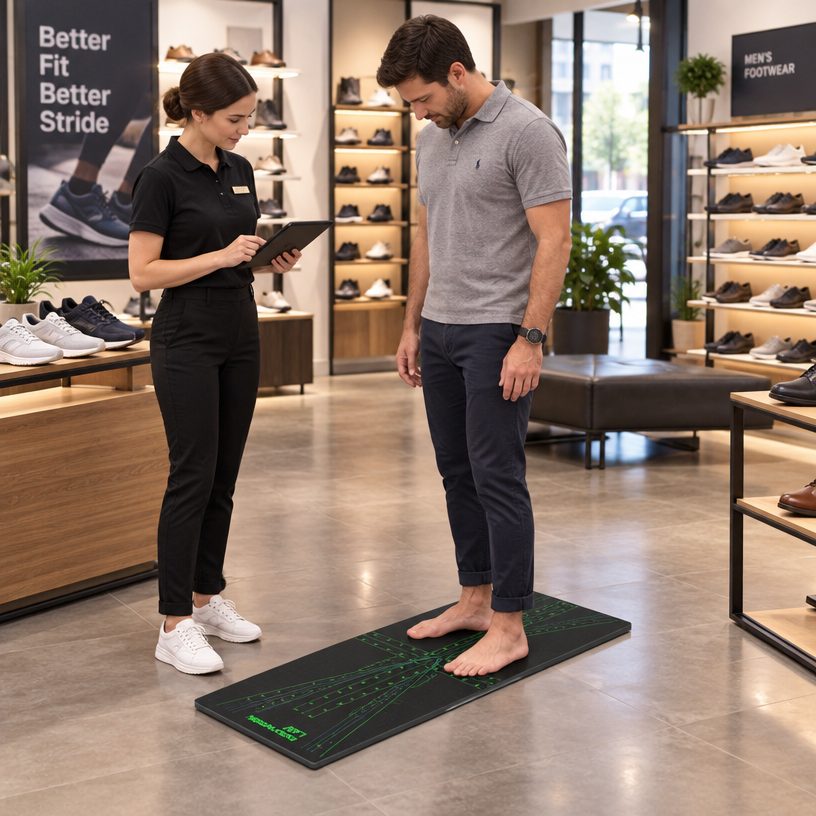
Sometimes the family did not come along — they sent the customer. The daughter made the call, chose the practice, drove the mother in, and will carry out whatever is decided afterwards. In sessions like this the family’s account is not background noise; it is intake data, often the richest intake data in the room. Ask them what they noticed, in their own words, and write it down exactly as said. “She holds the doorframe to get out of the car” is worth more than most formal descriptors, and it costs the family one sentence to give.
The family is also the audience for the explanation that follows the measurement. When the walk is done and the record exists, the professional’s explanation lands best when the people who will support the customer at home hear it directly — the same words, at the same time, from the same qualified person. What the family must not receive is an interpretation from the operator at the desk; describing what was measured and what was said is the operator’s job, and saying what it means belongs one step up the chain. The distinction is small in words and large in practice, and families respect it once it is explained plainly.
Through all of it the equipment’s part stays deliberately small. A plantar pressure and posture system such as the F2P records a crossing with the same indifference whether one person is watching or four, and deciding what that record means is the qualified professional’s work, not the machine’s and not the room’s. The full room’s job is simpler: give that professional an honest walk and honest words, and the record will be worth the extra chairs.
Frequently asked questions
Should family members be asked to wait outside during the capture?
Not as a rule. A family that stays feels cared for and often behaves better once given a role and a shape for the session. Reserve the empty room for the rare sessions where it is genuinely needed, and treat “family stays” as the default managed properly rather than the exception to be banned.
Is it a problem if the customer’s daughter answers the intake questions?
It becomes a problem only when it is invisible. Ask the customer first, by name, and wait for her answer. If a family member adds to it, record the addition as her report, labelled and separate. Second-hand answers that quietly replace first-hand ones are the real risk, not the presence of the daughter.
What should I do about someone filming the screen?
Allow it with boundaries: film the finished record, not the walk. Offer a proper copy through your usual channel so the phone becomes optional. Forbidding filming turns a caring gesture into a conflict the customer stands in the middle of, and gains nothing the boundaries do not already secure.
How do I stop the customer walking differently when the family is watching?
You soften it rather than stop it. Give the family a task, keep talking in your ordinary voice through the walk, and take extra passes — the performed walk is usually the first one, and the ordinary walk surfaces two or three crossings later. Note on the sheet which pass serves as the reference.
What should I write on the record when family members were present?
Three lines: who was present and who answered the questions; anything the family volunteered, in their words and labelled as their report; and which pass was used as the reference. A record taken in a full room carries those conditions with it, and the next reader of the file needs them.
Can family observations go in the file?
Yes, as descriptions with a named source. “The daughter reports her mother slows by late afternoon” is context a professional can weigh. What must not happen is a family remark drifting into the file dressed as a finding. Descriptions from the room, conclusions from the professional.
How many passes make a fair record in a busy room?
More than a quiet-room session, because the first crossings tend to carry the performance. There is no fixed number; the working rule is to keep going until the walk stops being presentational, then take the reference pass there and note on the sheet which one it was.
What we would do next
Two changes for this week, both cheap. First, the greeting card: the four beats written out and kept where the welcome happens, so the full room gets the same session on Thursday as on Monday. Second, one new line on the worksheet — who was present, and which pass served as the reference — so the conditions of a fuller room travel with the file the way arrival times and settling windows already do. Neither change requires the family to leave, which is the point.
The wider habit behind both is the one that governs every condition a session inherits: name it, write it down, and let the professional reading the whole file decide what it weighs. We have made the same argument for sessions that run through an interpreter (Two Languages, One Walk: Running an Assessment Through an Interpreter) — a fuller room is its cousin, attention splitting across more people instead of more languages — and for records that need several passes before they settle (Walk In, Walk Across: How Many Passes Make a Fair Record).
And a question for the rooms that never seem to be empty: when the daughter answers the first three questions before your customer gets a word in, what exactly do you write on the sheet — and has that line survived contact with a genuinely protective family yet? We would genuinely like to hear how other practices handle it.
This article is intended for professional and educational reference. It is not medical advice. Foot assessment equipment produces measurements and images; clinical interpretation and any decision about care remain the responsibility of a qualified professional. Certification scope is limited to the documentation we hold: European Union certification and ISO quality system certification.